

Aquarium Water Parameters: The Complete Beginner’s Guide (2026)
- 🐠 QUICK ANSWER: AQUARIUM WATER PARAMETERS
- ✅ The core four parameters every keeper must monitor: ammonia, nitrite, nitrate, and pH
- ✅ In a fully cycled tank: ammonia = 0 ppm, nitrite = 0 ppm, nitrate under 20 ppm for most fish
- ✅ pH stability matters more than hitting a perfect number – sudden swings harm fish more than a slightly off reading
- ✅ The nitrogen cycle takes 4 to 6 weeks to establish – it cannot be skipped or safely rushed
- ⚠️ New Tank Syndrome – ammonia and nitrite spikes in uncycled tanks – is the leading cause of fish death for beginners
- ⚠️ Weekly 25-50% water changes are non-negotiable for long-term parameter stability
- ❌ Never clean filter media with tap water – chlorine kills the beneficial bacteria that process ammonia
- This article is based on aquatic chemistry research, guidance from the American Fisheries Society, and peer-reviewed studies on nitrification processes in closed aquatic systems.
- Last Updated: April 2026
An aquarium is a closed system. Unlike a river or lake where water constantly renews itself and dilutes waste, a home fish tank holds the same water while fish continuously produce ammonia through waste and respiration. Without understanding how to manage the chemistry of that water, even the healthiest-looking tank can become toxic within days.
Water parameters are the measurable chemical properties of your tank water. They determine whether your fish thrive, struggle, or die. The good news is that managing aquarium water chemistry is far simpler than it sounds. Once you understand what each parameter does and why it matters, monitoring and maintaining your tank becomes straightforward and routine.
This guide explains every essential parameter from first principles – what it is, why it matters, what the safe ranges are, and exactly what to do when readings go wrong.
Why Water Parameters Matter More Than Anything Else
Fish are completely immersed in their environment every moment of their lives. Water quality is not one factor among many – it is the foundation of everything. Poor water quality suppresses immune function, causes chronic stress, creates respiratory distress, and produces conditions where disease takes hold rapidly.
Most fish deaths that appear sudden are not sudden at all. Invisible deterioration in water chemistry – ammonia rising slowly, pH shifting gradually – stresses fish over days or weeks before visible symptoms appear. By the time a fish looks unwell, the chemistry problem has usually been present for some time.
Understanding and monitoring parameters gives you the ability to intervene before fish show symptoms – which is always the right time to act.
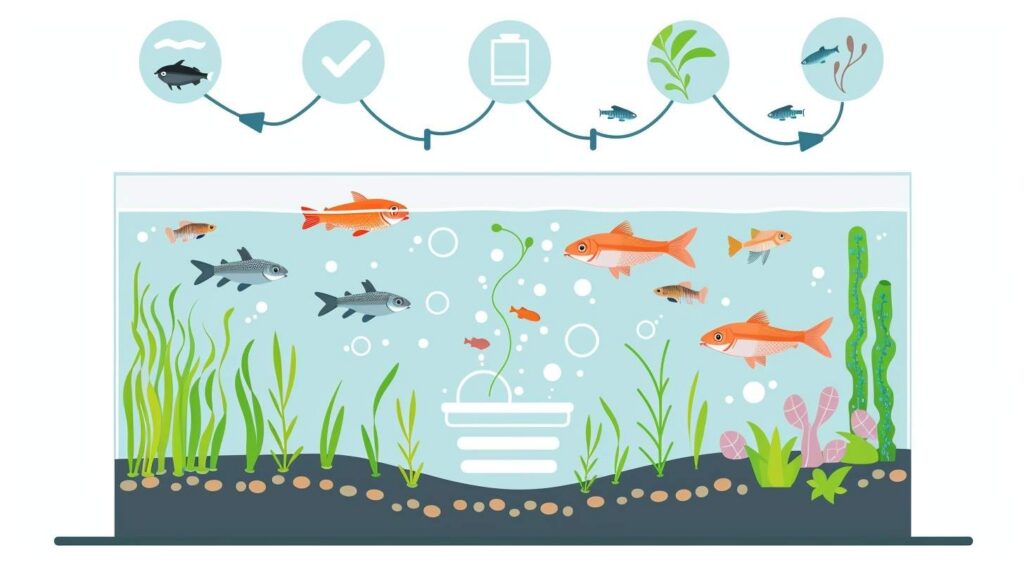
The Nitrogen Cycle: The Foundation of Everything
Before covering individual parameters, understanding the nitrogen cycle is essential. Every water parameter problem in an aquarium traces back to this cycle in some way.
How the Nitrogen Cycle Works
Fish produce ammonia continuously through waste and respiration. Ammonia is highly toxic to fish – even tiny amounts cause gill damage and organ stress. Left unmanaged, ammonia accumulates rapidly in a closed system and kills fish.
The nitrogen cycle solves this problem through beneficial bacteria:
Stage 1: Nitrosomonas bacteria colonize filter media and convert toxic ammonia into nitrite. Stage 2: Nitrobacter and Nitrospira bacteria convert toxic nitrite into nitrate. Stage 3: Nitrate – far less toxic than ammonia or nitrite – accumulates slowly and is removed through regular water changes and plant uptake.
Cycling a New Tank
A new tank has no established bacterial colonies. Without those bacteria, ammonia from fish waste accumulates unchecked – a condition called New Tank Syndrome. Adding fish to an uncycled tank is the most common cause of fish death for new aquarium keepers.
Establishing the nitrogen cycle takes 4 to 6 weeks. During this period:
| Week | What Happens |
|---|---|
| Week 1-2 | Ammonia rises as first bacteria begin colonizing |
| Week 2-3 | Nitrite appears as ammonia-converting bacteria establish |
| Week 3-4 | Ammonia begins to fall as bacterial colony grows |
| Week 4-6 | Both ammonia and nitrite reach 0 ppm; nitrate appears |
| Cycle complete | Ammonia 0 ppm, nitrite 0 ppm, nitrate rising slowly |
Speeding up the cycle:
- Add filter media or substrate from an established, healthy tank
- Use commercially available bacterial starter products such as Seachem Stability
- Maintain proper temperature – bacteria establish faster in warmer water
- Add ammonia source (fish food or pure ammonia) to feed developing bacteria during fishless cycling
A tank is fully cycled when both ammonia and nitrite consistently read 0 ppm for at least one full week.
The Core Four Parameters
1. Ammonia (NH3/NH4+)
Ammonia is the most immediately dangerous parameter in any aquarium. Even trace amounts damage fish gills, suppress immune function, and cause internal organ stress.
| Reading | Status | Action Required |
|---|---|---|
| 0 ppm | Safe | Continue regular maintenance |
| 0.25 ppm | Warning | 25-30% water change immediately |
| 0.5 ppm | Dangerous | 40-50% water change, check filter |
| 1 ppm+ | Emergency | Large immediate water change, add ammonia detoxifier |
Sources of ammonia spikes:
- Uncycled or newly set up tank
- Overfeeding – uneaten food decomposes and releases ammonia
- Overstocking – too many fish for the filter’s bacterial capacity
- Dead fish left in the tank
- Filter disruption – cleaning filter media with tap water kills bacteria
Emergency treatment: Seachem Prime detoxifies ammonia, nitrite, and nitrate for 24-48 hours, buying time to perform water changes and allow bacteria to recover.
New pet? Find a name that truly fits who they are.
Browse 6,500+ names for dogs, cats, birds, reptiles, rabbits and more — filtered by personality.
Try Pet Name Finder2. Nitrite (NO2-)
Nitrite is produced when bacteria break down ammonia. It is less immediately lethal than ammonia but still highly toxic. Nitrite binds to hemoglobin in fish blood, preventing oxygen transport – a condition sometimes called Brown Blood Disease. Fish experiencing nitrite toxicity often gasp at the surface and their gill filaments turn from bright red to dull brown or grey.
| Reading | Status | Action Required |
|---|---|---|
| 0 ppm | Safe | Continue regular maintenance |
| 0.25 ppm | Warning | 25% water change, check stocking and feeding |
| 0.5 ppm+ | Dangerous | Large water change immediately, add Seachem Prime |
Nitrite spikes typically follow ammonia spikes. If you see nitrite rising, the cycle has been disrupted or the tank is still establishing. Like ammonia, the only acceptable long-term level in a cycled tank is zero.
3. Nitrate (NO3-)
Nitrate is the end product of the nitrogen cycle – far less toxic than ammonia or nitrite, but still harmful at high concentrations. Long-term exposure to high nitrate levels stresses fish, stunts growth, compromises immune function, and promotes algae growth.
| Reading | Freshwater Fish | Sensitive Species | Action |
|---|---|---|---|
| 0-10 ppm | Excellent | Excellent | Ideal – maintain through water changes |
| 10-20 ppm | Good | Good | Normal range – weekly water changes |
| 20-40 ppm | Acceptable | Warning | Increase water change frequency |
| 40-80 ppm | Stressful | Dangerous | Immediate water change, review feeding |
| 80 ppm+ | Dangerous | Emergency | Large water change, review stocking and feeding |
Reducing nitrate:
- Weekly 25-50% water changes are the most reliable method
- Live plants absorb nitrate as fertilizer
- Reducing feeding frequency decreases waste production
- Reducing stocking density lowers overall biological load
4. pH
pH measures how acidic or alkaline your water is on a scale from 0 to 14. A pH of 7 is neutral, below 7 is acidic, and above 7 is alkaline. Most freshwater community fish thrive in a range of 6.5 to 7.5.
| pH Range | Description | Suitable For |
|---|---|---|
| 6.0-6.5 | Acidic | Soft water species – discus, tetras, angelfish |
| 6.5-7.5 | Neutral | Most community fish – livebearers, corydoras, danios |
| 7.5-8.5 | Alkaline | Hard water species – African cichlids, livebearers |
The most important rule about pH: Stability matters more than hitting a specific number. Fish adapt to a wide range of pH values over time, but rapid swings – even within the “safe” range – cause significant stress and can kill fish.
A fish accustomed to a stable pH of 7.8 handles that reading better than a fish experiencing swings between 7.0 and 8.0. Test pH regularly and aim for consistency rather than perfection.
Why pH changes:
- CO2 injection in planted tanks lowers pH during the day
- Low KH (carbonate hardness) leaves pH unstable and prone to rapid drops
- Driftwood and peat moss release tannins that gradually lower pH
- Tap water pH varies by region and season
Secondary Parameters
GH (General Hardness)
GH measures dissolved mineral content – primarily calcium and magnesium ions. It indicates how “hard” or “soft” your water is.
| GH Range | Description | Suitable For |
|---|---|---|
| 0-4 dGH | Very soft | South American species, discus |
| 4-8 dGH | Soft to medium | Most tropical community fish |
| 8-12 dGH | Medium to hard | Livebearers, goldfish, most community fish |
| 12+ dGH | Very hard | African cichlids, certain livebearers |
KH (Carbonate Hardness / Alkalinity)
KH measures carbonate and bicarbonate ions. Its primary role is pH buffering – KH absorbs acid and prevents pH from dropping suddenly. Low KH leaves pH unstable and vulnerable to rapid swings.
A KH of at least 4-6 dKH provides reliable pH stability for most community tanks. If your KH is very low and pH is unstable, adding crushed coral or limestone to the filter raises KH naturally.
Temperature
Temperature affects fish metabolism, immune function, and the oxygen content of the water. Most tropical freshwater fish thrive at 75-82°F (24-28°C).
| Fish Type | Optimal Temperature |
|---|---|
| Tropical community fish | 75-82°F (24-28°C) |
| Goldfish, white cloud minnows | 65-72°F (18-22°C) |
| Discus | 82-86°F (28-30°C) |
| African cichlids | 76-82°F (24-28°C) |
Temperature affects ammonia toxicity significantly. At higher temperatures, a greater proportion of total ammonia exists in the more toxic free ammonia (NH3) form rather than the less toxic ammonium (NH4+) form. This means a given ammonia reading is more dangerous in a warm tank than a cold one.

How and When to Test
Essential Test Equipment
| Test Method | What It Tests | Accuracy | Best For |
|---|---|---|---|
| Liquid test kit (API Master Kit) | Ammonia, nitrite, nitrate, pH | High – laboratory grade | Reliable ongoing testing |
| Test strips | pH, KH, GH, nitrite, nitrate (varies) | Moderate | Quick daily checks – less accurate |
| Digital pH meter | pH only | Very high | Planted tanks, precise monitoring |
The API Master Test Kit – a liquid-based kit testing ammonia, nitrite, nitrate, and pH – is the standard recommendation for new and experienced keepers. Test strips are convenient but significantly less accurate and cannot test ammonia.
Testing Frequency
| Tank Status | Testing Schedule |
|---|---|
| New tank cycling (no fish) | Daily or every other day |
| New tank cycling (with fish) | Daily |
| Established tank | Once per week |
| After any change (new fish, medication, water change) | Daily for 3-5 days |
| Fish showing stress or illness | Immediately |
Recording your test results in a logbook or app creates a trend picture – gradual parameter drift shows up in a log before it becomes a crisis. A single reading tells you where you are; a series of readings tells you which direction you are heading.
Water Changes: The Most Powerful Tool
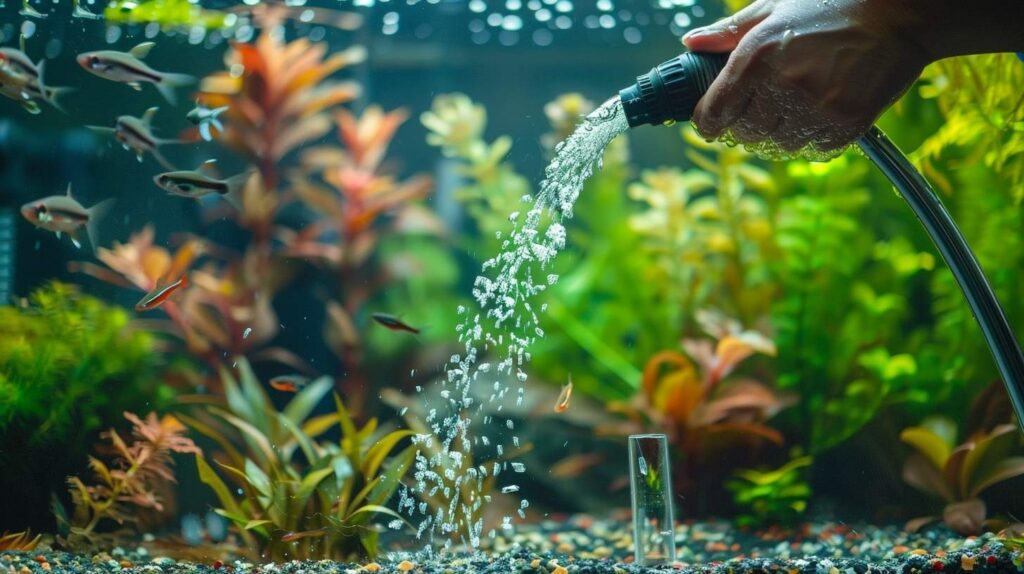
Regular water changes are the simplest, most reliable, and most important maintenance task in aquarium keeping. They dilute accumulated nitrate and other dissolved waste products, replenish trace minerals, and reset the chemical baseline of the tank.
Water Change Schedule
| Tank Type | Recommended Change | Frequency |
|---|---|---|
| Standard community tank | 25-30% | Weekly |
| Heavily stocked tank | 30-50% | Weekly |
| Lightly stocked planted tank | 20-30% | Weekly |
| During cycling | 25-30% | Every 2-3 days if ammonia exceeds 0.5 ppm |
Tap Water Treatment
Tap water contains chlorine or chloramine – disinfectants that kill beneficial bacteria and harm fish. Always treat tap water with a dechlorinator before adding it to the tank. Seachem Prime, API Stress Coat, and similar products neutralize chlorine and chloramine instantly at the point of use.
Match the temperature of replacement water as closely as possible to the tank temperature before adding. Sudden cold water additions shock fish and suppress immune function.
Did your bird eat something dangerous? Find out right now.
Enter what they ate — get an instant toxicity assessment for birds, parrots, and all feathered pets.
Check Toxicity NowCommon Parameter Problems and Solutions
| Problem | Likely Cause | Solution |
|---|---|---|
| Ammonia rising in established tank | Overstocking, overfeeding, dead fish, disrupted filter | Water change, remove dead fish or uneaten food, check filter |
| Nitrite spike in established tank | Filter disruption (cleaned with tap water), added too many fish at once | Water change, add Seachem Stability, reduce feeding |
| pH dropping gradually | Low KH, CO2 accumulation, decomposing organic matter | Regular water changes, add crushed coral or limestone to filter |
| pH swinging daily | Very low KH | Raise KH with buffer products or crushed coral |
| Persistent high nitrate | Overfeeding, overstocking, infrequent water changes | Increase water change size and frequency, reduce feeding, add plants |
| Cloudy white water | Bacterial bloom in new or disrupted tank | Normal and temporary – do not treat, do not add fish |
| Green cloudy water | Algae bloom from excess light and nutrients | Reduce lighting hours, increase water changes, add fast-growing plants |
Frequently Asked Questions
Understanding the Cycle
How do I know when my tank is fully cycled? A tank is fully cycled when ammonia consistently reads 0 ppm and nitrite consistently reads 0 ppm for at least seven consecutive days while nitrate is present and rising. Both ammonia and nitrite at zero simultaneously for a full week confirms a stable bacterial colony. Test daily during the final stages of cycling to confirm the readings are stable, not just temporarily low.
Can I add fish before the cycle is complete? Adding fish before cycling is complete exposes them to toxic ammonia and nitrite spikes. If you must add fish during cycling, stock very lightly, feed minimally, perform frequent 25-30% water changes to keep ammonia and nitrite from reaching lethal levels, and use Seachem Prime daily to detoxify harmful compounds while the cycle establishes.
My established tank suddenly has ammonia – what happened? Three causes account for most ammonia spikes in established tanks. A dead fish decomposing in the tank is common – check thoroughly, including behind decorations. Filter media cleaned with tap water kills the beneficial bacteria colony instantly. Sudden overstocking – adding too many fish at once – overwhelms the existing bacterial capacity before it can expand.
Testing and Maintenance
How often should I do water changes? Weekly water changes of 25-50% are the standard recommendation for most community tanks. Consistency matters more than exact volume – weekly small changes outperform monthly large ones for parameter stability. If nitrate consistently exceeds 20 ppm between changes, increase the volume or frequency.
My pH is outside the recommended range but my fish seem fine – should I adjust it? In most cases, leave it alone. Fish that have been living in your water for weeks or months have adapted to its specific chemistry. Attempting to adjust pH with chemicals often creates instability that is far more stressful than a stable but slightly off-range reading. Only adjust pH when introducing fish from a dramatically different water chemistry, and do so gradually over days, not hours.
Do I need to test water if I do regular water changes? Yes. Water changes maintain parameters but cannot predict or prevent all problems. Filter disruption, overfeeding, equipment failure, and overstocking can all cause parameter spikes between water changes. Weekly testing alongside weekly water changes catches problems before they become emergencies.
Key Takeaways
- Ammonia and nitrite must always read 0 ppm in a cycled tank – any reading above zero needs immediate action
- The nitrogen cycle takes 4 to 6 weeks to establish – never add fish to an uncycled tank
- pH stability matters far more than hitting a specific number – prevent swings, not readings
- Weekly 25-50% water changes are the single most effective maintenance tool in aquarium keeping
- Never clean filter media with tap water – always use old tank water to preserve beneficial bacteria
- The API liquid test kit provides reliable results that test strips cannot match for ammonia
- Recording test results over time reveals trends before they become problems
This article is for informational purposes only. For species-specific water chemistry requirements, consult the specific care needs of the fish you intend to keep, as requirements vary significantly between species.

