Dalmatian: Complete Breed Guide – Temperament, Care, Health & More (2026)
🐕 QUICK ANSWER: DALMATIAN BREED GUIDE
- ✅ Dalmatians are athletic, energetic, and highly intelligent – one of the most visually distinctive breeds in the world
- ✅ No two Dalmatians have identical spot patterns – every dog is unique, like a fingerprint
- ✅ Males and females: 45-70 lbs – lean, muscular, and built for sustained athletic endurance
- ✅ Historically the coach dog – bred to run alongside horse-drawn carriages for hours, often covering 20-30 miles per day
- ✅ Loyal, affectionate, and deeply bonded to their family – excellent family companions when their needs are met
- ⚠️ Deafness affects approximately 8% of Dalmatians bilaterally and 22% unilaterally – BAER testing of all puppies is essential
- ⚠️ A unique urinary system predisposes all Dalmatians to urate stones – dietary management is critical throughout the dog’s life
- ⚠️ Very high energy – a Dalmatian that does not receive 90-120 minutes of vigorous daily exercise becomes hyperactive, anxious, and destructive
- ⚠️ The 101 Dalmatians effect creates waves of impulse purchases that families often return to shelters – Dalmatians are one of the most surrendered breeds
- ❌ Do NOT acquire a Dalmatian based on appearance without researching the breed’s genuine exercise and management requirements
- ❌ Do NOT feed a Dalmatian a standard high-protein dog food without veterinary guidance – urate stone risk requires lifelong dietary management
- This article draws on breed standards from the American Kennel Club (AKC) and The Dalmatian Club of America (DCA), health research from the DCA Health Committee and peer-reviewed studies on Dalmatian urinary biochemistry, and clinical guidance from veterinary urologists and audiologists specializing in breed-specific health conditions.
- Last Updated: May 2026
What Kind of Dog Is a Dalmatian?
Origins and the Coach Dog Role
The Dalmatian’s exact origin is one of the most debated topics in canine history. Despite its name suggesting Croatian origin – the region of Dalmatia on the Adriatic coast – definitive proof of the breed’s geographic development remains elusive. Notably, spotted dogs resembling Dalmatians appear in ancient Egyptian tomb paintings, in ancient Greek friezes, and in artifacts from the Indus Valley civilization. The breed’s extraordinary geographic spread through ancient trade routes makes pinning down a single origin region genuinely difficult.
The earliest clear European documentation of the breed appears in 18th-century Croatia – a 1719 painting by Petar Ritter Vitezović in Dalmatia shows a dog matching the modern Dalmatian’s description, and Thomas Pennant’s 1771 publication “Synopsis of Quadrupeds” describes the breed and names it the Dalmatian. These references established the Croatian connection in the breed’s official name. However, the breed was likely already well-distributed across Europe before this documentation.
What history makes unambiguous is the Dalmatian’s role as the coach dog of the 18th and 19th centuries. Wealthy European and American households valued them to run alongside horse-drawn carriages – a role that served multiple functions. Specifically, Dalmatians calmed horses, since breeders developed them to work closely with horses and created an unusual affinity for them. Furthermore, they guarded the carriage and horses when stationary, and provided an impressive visual accompaniment to wealthy households demonstrating their status on public roads.
The American Fire Station Connection
In the United States, this carriage-running heritage transferred directly to the fire service. Historically, fire departments used horse-drawn steam engines, and Dalmatians ran with the horses to clear pedestrians from the path and guard equipment at fire scenes. This association became so ingrained in American culture that the Dalmatian remains the symbolic mascot of fire departments across the country – appearing on children’s books, toys, and fire station murals more than a century after horse-drawn fire engines disappeared.
The 101 Dalmatians Effect
The 1956 Dodie Smith novel “The Hundred and One Dalmatians” and its 1961 Disney animated adaptation created an enormous and recurring wave of public interest in the breed. Consequently, each major film release produces a surge of Dalmatian purchases by families attracted to the breed’s appearance without understanding its genuine needs. As a result, a corresponding wave of Dalmatian surrenders to shelters follows within 12-18 months, as those families discover the breed is not the mild-mannered, adaptable dog the film implies.

At a Glance: Dalmatian Quick Reference
| Category | Details |
|---|---|
| AKC group | Non-Sporting Group |
| Origin | Uncertain – documented in Dalmatia (Croatia), 18th century |
| Height | 19-24 inches |
| Weight | 45-70 lbs |
| Lifespan | 11-13 years |
| Energy level | Very high |
| Exercise needed | 90-120 minutes per day |
| Grooming | Low – weekly brushing |
| Shedding | High – year-round, fine white hairs embed in fabric |
| Trainability | Good – intelligent but sensitive and independent |
| Good with children | Yes – older children with adequate exercise |
| Good with other dogs | Generally yes with socialization |
| Good with cats | Variable – prey drive present |
| Bilateral deafness risk | 8% of breed |
| Unilateral deafness risk | 22% of breed |
| Urate stone risk | All Dalmatians – dietary management essential |
| Apartment suitable | No – very high exercise needs |
| First-time owner suitable | Not recommended |
Dalmatian Temperament: The Reality Behind the Film
The Coach Dog Personality
The Dalmatian’s working history as a coach dog produced a specific temperament profile: high energy for sustained running, strong stimulus-seeking behavior, independence when working alongside horses, and alertness to the environment that translates domestically into a dog that notices, reacts to, and investigates everything in its surroundings.
A well-exercised Dalmatian is an engaged, cheerful, and affectionate companion. In contrast, an under-exercised one is hyperactive, destructive, and genuinely difficult to manage. This distinction explains the breed’s consistent pattern of purchase surge and shelter return that follows every film release.
Sensitivity and Emotional Responsiveness
Dalmatians are emotionally sensitive dogs that respond strongly to their owner’s tone and mood. Specifically, they do not tolerate harsh corrections – punitive training creates anxiety that produces reactive and unpredictable behavior rather than compliance. Positive, consistent, patient training produces excellent results.
This sensitivity also means Dalmatians are acutely aware of household tension. They thrive in stable, emotionally consistent environments and show behavioral changes – restlessness, anxiety, and increased reactivity – when the household atmosphere is unstable.
Energy and the Exercise Imperative
The most important behavioral fact about Dalmatians is their genuine athletic capability and drive. Indeed, a dog bred to run 20-30 miles alongside a carriage on cobblestone roads has endurance that the average family walk cannot satisfy. Dalmatians need genuine running – sustained cardiovascular activity – rather than simply extended walks.
Owners who provide this daily exercise find Dalmatians to be excellent companions: settled indoors, affectionate, and well-mannered. However, owners who do not provide it find a dog with energy that has nowhere to go – expressed as destructive behavior, persistent jumping, hyperactive greeting, and an inability to settle.
Affection and Family Loyalty
Well-exercised Dalmatians are genuinely devoted to their family. They form strong bonds, express affection through physical closeness, and show particular warmth with older children who can match their energy level. Furthermore, their loyalty is consistent and deep within the established household.
The Spot Pattern: Genetics and Uniqueness
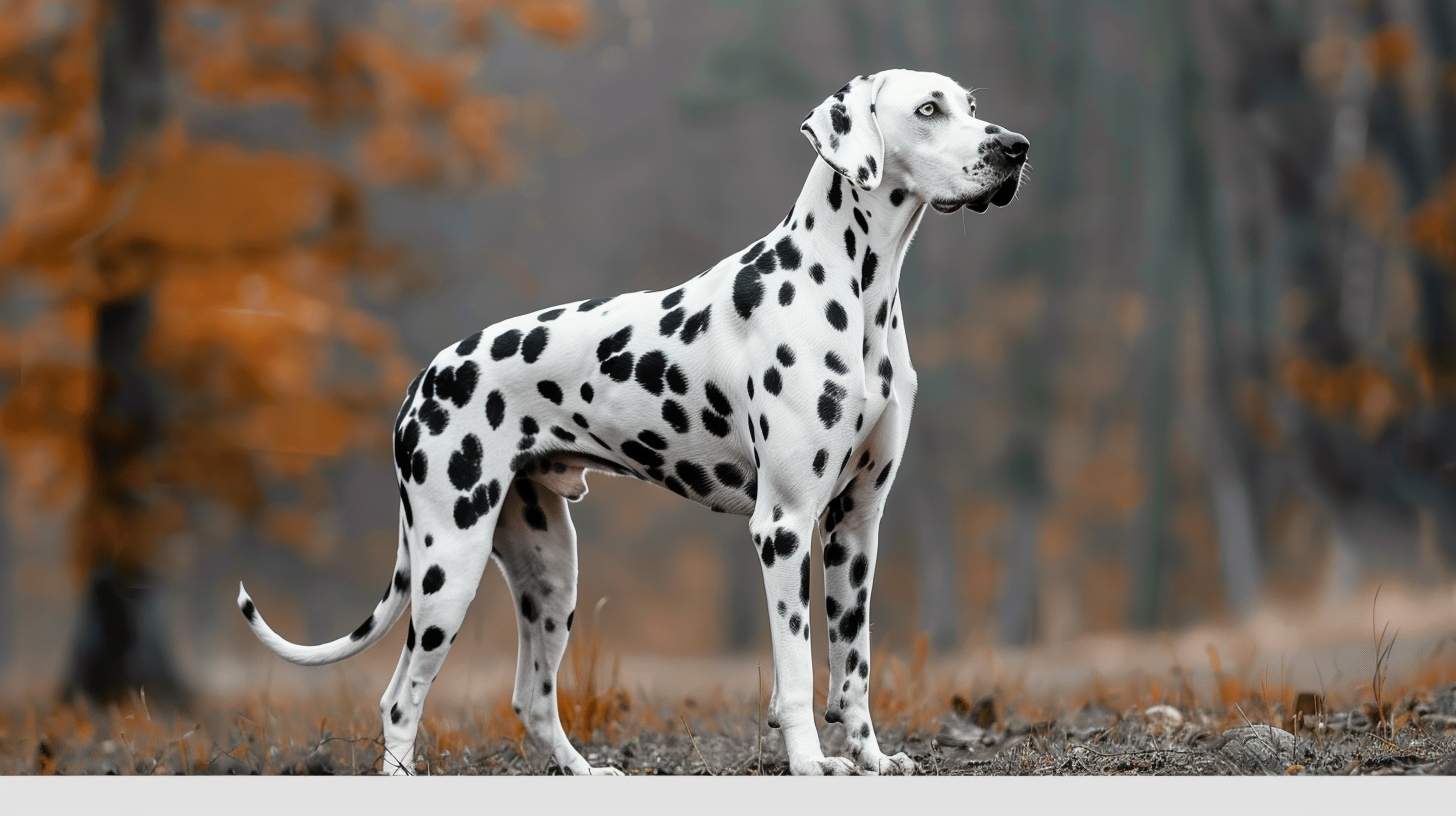
Every Dalmatian is born completely white. Spots appear over the first 3-4 weeks of life as melanocyte migration populates the skin. Notably, no two Dalmatians develop identical spot patterns – the distribution and size of spots is individually unique, much like a fingerprint.
| Spot Color | Notes |
|---|---|
| Black spots | Most common – on white background |
| Liver spots | Brown spots on white – second most common |
| Lemon | Pale yellow spots – rare |
| Blue | Dilute grey spots – rare |
| Tricolor | Black or liver spots plus tan markings – rare |
AKC breed standard specifies distinct, well-distributed spots of approximately the same size. Large patchy areas (“patches”) are a fault in the show ring but do not affect the dog’s health or temperament.
Deafness: The Breed’s Most Significant Health Concern
The Piebald Gene Connection
The same extreme piebald gene responsible for the Dalmatian’s white coat reduces melanocyte presence in the cochlear stria vascularis – the inner ear structure essential for normal hearing. This connection between white coat genetics and deafness is the same mechanism researchers identify in Dogo Argentinos and other heavily white-coated breeds.
Approximately 8% of Dalmatians are bilaterally deaf (both ears) and 22% are unilaterally deaf (one ear). These rates are among the highest of any breed.
Bilateral vs Unilateral Deafness
| Type | Impact | Detectability without testing |
|---|---|---|
| Bilateral deafness | Severe – dog cannot hear at all | Usually detected by owners |
| Unilateral deafness | Moderate – one ear functional | Often undetected without BAER test |
Unilateral deafness is particularly important to detect because it is rarely apparent in daily life – a dog with one functional ear appears to hear normally. However, unilateral deaf dogs bred to other unilateral deaf dogs have significantly elevated risk of producing bilaterally deaf offspring. Consequently, responsible breeders BAER test all puppies and never breed bilaterally deaf dogs.
Every Dalmatian puppy must receive BAER testing before purchase. Buyers should request the test certificate as standard documentation.
Urate Stones: The Unique Dalmatian Metabolism
Why All Dalmatians Are Affected
Unlike every other dog breed, Dalmatians carry a unique genetic mutation in the SLC2A9 gene that affects uric acid metabolism. Specifically, other breeds convert uric acid to allantoin, which is soluble and easy to excrete. Dalmatians cannot complete this conversion, causing uric acid accumulation and the formation of urate stones in the bladder and sometimes the kidneys.
Importantly, this is not a condition affecting some Dalmatians – it is universal to all Dalmatians due to the breed’s unique genetics. Therefore, every Dalmatian requires lifelong dietary management to minimize urate stone risk.
Dietary Management
| Food Category | Risk Level | Notes |
|---|---|---|
| High-purine meats (organ meats, anchovies, sardines, game) | High | Avoid entirely |
| Regular beef and lamb | Moderate | Limit in diet |
| Chicken, turkey, eggs | Lower | Better protein sources |
| Fish (non-oily) | Lower | Generally acceptable |
| Plant-based proteins | Low | Good dietary supplement |
| Water | Critical | High water intake essential – promotes urine dilution |
Owners should feed a moderate-protein diet using lower-purine protein sources, ensure very high daily water intake, and maintain a healthy weight that minimizes urinary tract stress. Furthermore, veterinary monitoring including periodic urinalysis identifies early stone formation before clinical signs appear.
Signs of Urinary Problems
Signs of urate stone complications include frequent urination, straining to urinate, blood in urine, or sudden inability to urinate. The last – complete urinary obstruction – is a veterinary emergency requiring immediate treatment.
Health: Common Conditions in Dalmatians
Health Conditions Overview
| Health Condition | Prevalence | Signs to Watch For | Action |
|---|---|---|---|
| Congenital deafness | High – 30% some degree | BAER test required | Test every puppy before purchase |
| Urate bladder stones | Very high – universal risk | Straining to urinate, blood in urine | Dietary management, periodic urinalysis |
| Hip dysplasia | Moderate | Stiffness, abnormal gait | OFA evaluation on both parents |
| Iris sphincter dysplasia | Moderate – breed-specific | Sensitivity to bright light | Annual eye exam |
| Hypothyroidism | Moderate | Weight gain, lethargy, coat changes | Annual thyroid panel |
| Allergies (atopic dermatitis) | Moderate | Itching, recurrent skin infections | Dermatology referral |
| Epilepsy | Low-moderate | Seizures | Neurological evaluation |
Iris Sphincter Dysplasia
This Dalmatian-specific eye condition affects the muscle that controls pupil constriction, reducing the dog’s ability to restrict light entering the eye in bright conditions. Consequently, affected dogs show sensitivity to bright light – squinting outdoors, seeking shade, and appearing uncomfortable in sunlight. Annual eye examinations detect the condition early. Management focuses on avoiding excessive bright light exposure.
Grooming: Low Maintenance, High Shedding
Overall, the Dalmatian’s short, dense coat is easy to groom. However, it sheds continuously throughout the year. Notably, the fine white hairs are particularly visible on dark clothing and furniture and embed in fabric in ways that are difficult to remove.
| Grooming Task | Frequency | Notes |
|---|---|---|
| Brushing | Weekly | Rubber curry mitt removes loose hair |
| Bathing | Every 6-8 weeks | Short coat dries quickly |
| Ear cleaning | Every 2 weeks | Check for discharge and odor |
| Nail trimming | Every 3-4 weeks | Active dogs partially wear nails |
| Teeth brushing | 3-5 times per week | Dental disease prevention |
Exercise: Bred to Run
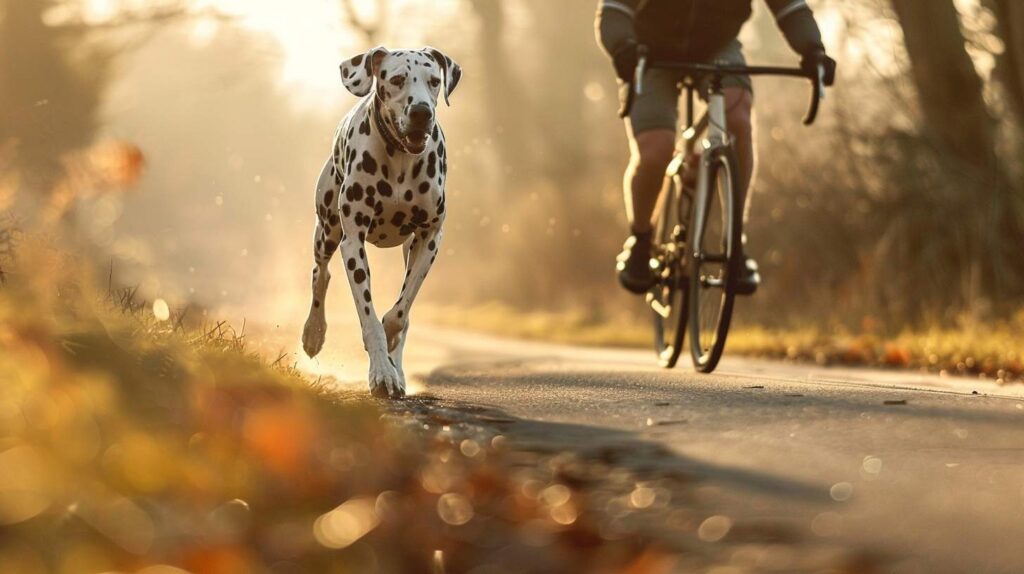
Dalmatians need 90-120 minutes of vigorous daily exercise including genuine running. Walks alone are insufficient – their coach dog heritage means they have endurance that demands cardiovascular outlets rather than gentle strolls.
| Exercise Type | Suitability | Notes |
|---|---|---|
| Running with owner | Exceptional | Natural and deeply satisfying |
| Cycling alongside owner | Excellent | High-intensity, sustainable |
| Fetch and sustained retrieval | Excellent | Drive outlet with handler |
| Hiking | Excellent | Mental and physical combined |
| Agility training | Excellent | Speed and intelligence combined |
| Off-leash in fenced area | Good | Prey drive requires secure fencing |
Training: Working With a Sensitive, Energetic Mind
Dalmatians are intelligent dogs that respond well to consistent, patient, positive training. Their sensitivity means harsh corrections produce anxiety rather than compliance. Furthermore, their intelligence means repetitive drills disengage them quickly.
| Training Priority | Why It Matters |
|---|---|
| Early socialization | Foundation of stable adult temperament |
| Loose leash walking | Energy and drive make pulling a default |
| Recall | Important for off-leash safety |
| Calm greeting behavior | Exuberant energy requires direction |
| Quiet command | Alert barking is moderate but consistent |

Is a Dalmatian Right for You?
Owners Who Succeed With Dalmatians
Dalmatians thrive with active runners, cyclists, or hikers who exercise daily. They also suit families with older children who can engage with the dog’s energy, owners who research the breed fully before acquiring, and anyone drawn to the breed’s genuine athletic capability, distinctive appearance, and loyal family temperament. Above all, anyone who can meet the daily exercise requirement will find the Dalmatian a deeply rewarding companion.
Households That Struggle With Dalmatians
In contrast, Dalmatians are consistently challenging for owners who acquired them primarily for their appearance, for families who cannot provide 90-120 minutes of running-level daily activity, for apartment residents, for first-time owners, and for anyone not prepared to manage lifelong dietary monitoring for urate stones.
New puppy? Find a name that fits their personality.
Browse 600+ dog names by gender and personality type — playful, calm, bold, elegant, funny or mysterious.
Try Pet Name FinderFrequently Asked Questions
Dalmatian History and Identity
Why are there so many Dalmatians in shelters? Specifically, the 101 Dalmatians effect is real and well-documented – every major film release produces a surge in Dalmatian purchases followed within 12-18 months by a wave of surrenders as families discover the breed’s genuine exercise and management needs. Dalmatians are consistently one of the most returned breeds to shelters in the United States following film releases. Consequently, the DCA and animal welfare organizations actively campaign against impulse purchasing of the breed.
Why are Dalmatians associated with fire stations? The association dates to the era of horse-drawn fire engines. Historically, Dalmatians ran with the horses to clear pedestrians from the path, and their unusual affinity for horses meant they calmed the horses during the stress of fire scenes. They also guarded the equipment when firefighters were at work. When motorized vehicles replaced horses, Dalmatians became symbolic mascots rather than working dogs – but the tradition persisted throughout American fire culture.
Dalmatian Health and Care
Are all Dalmatians born white? Yes. Dalmatian puppies are born completely white. Melanocytes migrate to the skin over the first 3-4 weeks of life, producing spots that appear progressively. Furthermore, the full spot pattern continues developing for several months. Breeders can assess puppies for spot color early, but the complete pattern takes time to emerge.
Can Dalmatians eat the same food as other dogs? No – not without risk. All Dalmatians carry a unique metabolic limitation that prevents normal uric acid processing. Standard high-protein dog foods, particularly those based on organ meats or high-purine proteins, significantly increase urate stone risk. Therefore, Dalmatians require a specifically managed diet using lower-purine protein sources and must have access to very high daily water intake throughout their lives.
Are Dalmatians good with young children? Better with older children who can participate in their exercise. Their high energy and exuberant greeting behavior means they can accidentally knock over young children through enthusiasm rather than aggression. Well-exercised Dalmatians are significantly calmer and safer around young children than under-exercised ones. Consequently, meeting the daily exercise requirement is the single most important factor in how the dog behaves with children.
How do I find a responsible Dalmatian breeder? A responsible Dalmatian breeder BAER tests all puppies and provides certificates, maintains OFA evaluations on breeding dogs, and tests for iris sphincter dysplasia. Additionally, they provide dietary guidance specific to the breed’s urate metabolism and do not sell puppies before 8 weeks. Importantly, they will ask about your lifestyle and exercise capacity honestly before placing a puppy.
Key Takeaways
- BAER testing of every puppy is non-negotiable – 30% of Dalmatians have some degree of deafness
- All Dalmatians have unique uric acid metabolism – lifelong dietary management is not optional
- The 101 Dalmatians effect causes thousands of impulse purchases and subsequent surrenders – research before acquiring
- 90-120 minutes of genuine running-level daily exercise is the foundation of all positive Dalmatian behavior
- Every Dalmatian is born white – spots develop over the first 3-4 weeks of life
- The fire station connection traces to real historical horse-drawn engine work, not fiction
- Iris sphincter dysplasia is a breed-specific eye condition causing light sensitivity
- The breed’s origin is genuinely uncertain despite its name – spotted dogs appear in ancient art across multiple civilizations
This article is for informational purposes only. Breed characteristics represent general tendencies and do not predict the behavior or health of any individual dog. Always consult a veterinarian for health advice, including specific dietary guidance for urate stone management.