How Much Should I Feed My Puppy? Complete Feeding Guide by Age & Breed Size (2026)
- Quick Answer: How much to feed a puppy depends on three things: age, current weight, and adult breed size. As a general rule, puppies need roughly 5% of their expected adult body weight in food per day, divided into multiple meals. Puppies under 12 weeks need 3–4 meals a day; 3–6 months need 3 meals; over 6 months need 2 meals. Always use the feeding guide on your specific food’s packaging as the starting point, then adjust based on your puppy’s body condition — and confirm with your vet at every check-up.
- Expert Source: Feeding guidelines in this article are drawn from recommendations by the American College of Veterinary Nutrition (ACVN), the American Kennel Club (AKC), PetMD’s veterinary nutrition team, and the Association for Pet Obesity Prevention. Breed-size specific guidance references the AKC Breed Weight Chart.
- Last Updated: March 2026
Feeding a puppy seems straightforward until you stand in front of the food aisle and realise there are 40 different products, each with a different feeding chart, for a dog whose weight you are still guessing. Add in competing advice from the breeder, the internet, and your neighbour, and it quickly becomes confusing.
The truth is that puppy feeding has a few clear principles that apply regardless of breed, food brand, or personal preference. Get these right and your puppy will grow steadily, maintain a healthy body condition, and avoid the two most common feeding mistakes: underfeeding (which stunts growth and causes deficiency) and overfeeding (which causes obesity and joint problems, particularly in large breeds).
This guide gives you everything you need.
Why Puppy Nutrition Is Different From Adult Dog Nutrition
Puppies are not small adult dogs. Their nutritional needs are fundamentally different — and feeding adult dog food to a puppy is not a safe shortcut.
According to the American College of Veterinary Nutrition, the first 12 months of a dog’s life are critical for developing a strong skeletal structure, healthy organs, and brain function. Puppy food is formulated to support this:
| Nutrient | Why Puppies Need More | What Happens Without It |
|---|---|---|
| Protein | Muscle and organ development | Stunted growth, poor muscle mass |
| Fat | Brain development, energy | Poor coat, low energy, cognitive issues |
| Calcium & Phosphorus | Bone and teeth formation | Skeletal deformities — especially large breeds |
| DHA (omega-3) | Brain and vision development | Reduced learning capacity |
| Calories per kg body weight | Puppies burn calories much faster than adults | Weight loss, lethargy, failure to thrive |
Puppy food contains around 27% protein, while adult dog food has just 21%. The extra protein helps with bone and muscle growth.
Feeding adult food to a growing puppy consistently leads to nutritional deficiencies that are difficult to reverse. Always use a food labelled “complete and balanced for puppies” or “all life stages.”
How Much to Feed a Puppy – By Age
6–12 Weeks
Between four and 12 weeks, young puppies need three or more feedings per day to adequately meet their nutritional needs. At this age, their stomachs are tiny and blood sugar regulation is immature — spreading food across multiple small meals prevents dangerous dips in blood sugar, particularly in small and toy breeds.
Toy and small-breed pups may need extra snacks at this stage, as they are susceptible to hypoglycemia (low blood sugar).
As a general starting point, aim for approximately 5% of your puppy’s expected adult body weight per day, divided across 3–4 meals. So a puppy expected to reach 10 kg as an adult would receive approximately 500 g of wet food per day, or the equivalent in dry kibble as specified on the packaging.
3–6 Months
When puppies reach 3 months old, their protein and fat requirements begin to decline — though they’re still greater than the amounts required in adulthood. At this stage, a puppy’s activity level ramps up, so their weight and body condition should be closely monitored.
Reduce to 3 meals per day. In general, large-breed dogs can make the switch from four to three meals at 12 to 14 weeks, while smaller breeds should drop the third serving around seven to nine weeks old.
Calorie needs per kilogram of body weight are still significantly higher than in adulthood — puppies need up to twice the daily calories per pound of body weight compared to adult dogs.
6–12 Months
By six months, most puppies can transition to two meals per day. Their growth rate is slowing, and their digestive system can handle larger, less frequent meals. Aim for about 20–30 calories per pound of body weight per day at this stage, but always consult your vet for breed-specific guidelines.
Continue feeding puppy-specific food — do not switch to adult food yet. The skeleton is still developing, and the calcium-to-phosphorus ratio in puppy food is calibrated to support this.
Puppy Feeding Chart by Breed Size
Breed size is the most important factor after age. Large and giant breeds have very different nutritional requirements from small breeds — overfeeding large breeds in puppyhood causes rapid growth that places destructive stress on developing joints.
| Breed Size | Adult Weight | Meals Per Day (Under 6 Months) | Switch to Adult Food |
|---|---|---|---|
| Toy | Under 5 kg | 4 meals — watch for hypoglycaemia | 9–12 months |
| Small | 5–12 kg | 3–4 meals | 10–12 months |
| Medium | 12–25 kg | 3 meals | 12–15 months |
| Large | 25–45 kg | 3 meals | 15–18 months |
| Giant | Over 45 kg | 3 meals — use large-breed formula | 18–24 months |
It’s best to feed puppy food until your dog has reached at least 80% of their adult size. Small breeds reach this size around 10–12 months, medium breeds around 12–15 months, and large breeds between 15–24 months.

Why Large Breeds Need a Special Formula
This is one of the most important and most overlooked aspects of puppy feeding. Large and giant breed puppies should not be fed regular puppy food — they need a formula specifically labelled for large breeds.
Standard puppy foods are high in calcium to support bone development. In large breeds growing rapidly, this excess calcium causes joints to develop too quickly relative to muscles and ligaments, leading to conditions like hip dysplasia, osteochondrosis, and developmental orthopaedic disease. Large breed puppy formulas supply additional nutrients to support joints specifically, while small breed formulas address the higher metabolic rate and preference for smaller kibble size in small breed dogs.
How Many Meals Per Day – Summary
| Age | Meals Per Day |
|---|---|
| 6–12 weeks | 4 meals |
| 3–6 months | 3 meals |
| 6–12 months | 2–3 meals |
| Over 12 months | 2 meals |
An easy feeding schedule to follow is to feed your puppy when you eat — at breakfast, lunch, and dinner. Remember to feed in the early evening so they have time to digest before bedtime — this helps prevent accidents overnight.
How to Tell If You Are Feeding the Right Amount
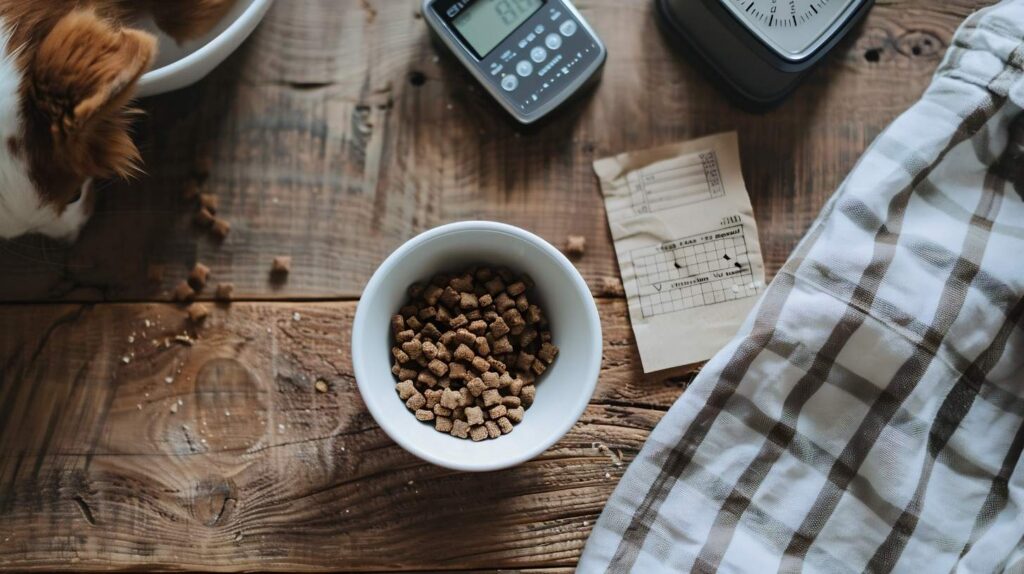
Feeding charts are starting points, not exact prescriptions. The right amount of food for your dog depends on several factors, including age, weight, activity level, and health status. Use the feeding chart on your dog food’s packaging as a starting point, then adjust based on your dog’s body condition and your veterinarian’s advice.
The Body Condition Score Method
Rather than relying solely on weight, use the body condition score (BCS) — a simple physical assessment:
Run your hands along your puppy’s ribcage. You should be able to feel individual ribs without pressing hard, but they should not be visibly prominent. Look down at your puppy from above — there should be a visible waist narrowing behind the ribs. From the side, the belly should tuck up slightly behind the ribcage.
| What You Feel/See | What It Means |
|---|---|
| Ribs easy to feel, visible waist | Ideal body condition |
| Ribs hard to feel, no visible waist | Overweight — reduce food by 10% |
| Ribs very prominent, no muscle mass | Underweight — increase food or see vet |
| Pot-bellied appearance in young puppy | Possible worm burden — see vet |
Puppies should grow between 10 to 15% of their body weight per day, ranging from about 0.5 ounces to 2.5 pounds per week. If your puppy is losing weight versus gaining weight, it may be a sign of a medical condition that requires your vet’s attention.

Dry Food vs Wet Food vs Raw – Which Is Best?
| Food Type | Pros | Cons | Best For |
|---|---|---|---|
| Dry kibble | Convenient, dental benefits, cost-effective | Lower moisture content | Most breeds, easy storage |
| Wet/canned | Higher moisture, often more palatable | More expensive, opens and spoils quickly | Fussy eaters, extra hydration |
| Raw | Unprocessed, high protein | Preparation time, bacterial risk, harder to balance | Experienced owners with vet guidance |
| Mixed (wet + dry) | Balance of benefits | Requires portion adjustment | Most owners’ preferred approach |
Whatever you choose, look for the phrase “complete and balanced” on the label, which indicates the food meets AAFCO (Association of American Feed Control Officials) nutritional standards. The food should be produced by a reputable company that has scientifically researched their foods by conducting feeding trials, and employs a nutritionist to help formulate their diets.
Switching Puppy Foods – How to Do It Safely
If you need to change your puppy’s food — for any reason — the transition must be gradual. Sudden food changes cause digestive upset in puppies, leading to vomiting, diarrhoea, and loss of appetite.
| Day | Old Food | New Food |
|---|---|---|
| 1–2 | 75% | 25% |
| 3–4 | 50% | 50% |
| 5–6 | 25% | 75% |
| 7+ | 0% | 100% |
If your puppy shows loose stools or vomiting during the transition, slow it down — extend each phase by another 2–3 days.
Common Puppy Feeding Mistakes
| Mistake | Why It Is a Problem |
|---|---|
| Feeding adult food to a puppy | Nutritional deficiencies, improper calcium ratios |
| Free-feeding (leaving food out all day) | Overfeeding, obesity, disrupts toilet training routine |
| Not adjusting portions as the puppy grows | Either underfeeding a growing puppy or overfeeding a maturing one |
| Feeding large-breed puppies regular puppy formula | Joint problems, skeletal disorders |
| Giving too many treats | 90% of calories should come from complete puppy food. The other 10% can come from treats. |
| Changing food suddenly | Vomiting, diarrhoea, food refusal |
| Ignoring body condition | Relying on charts alone rather than physically assessing the puppy |
If your puppy gets into something they should not have eaten, use our Pet Toxicity Calculator to check whether it poses a risk immediately.
Did your dog eat something dangerous? Find out right now.
Enter what they ate and their weight — get an instant toxicity assessment for 35+ substances.
Check Toxicity NowWhen to Switch From Puppy Food to Adult Food
There’s no harm in feeding a puppy diet into adulthood if the calories and amount of food provided are appropriately adjusted for your dog’s body weight and condition. Switching too early, however, removes the nutritional support the growing body needs.
The general guideline is to switch when your puppy reaches 80% of their expected adult size. For toy and small breeds this is around 9–12 months; for medium breeds 12–15 months; for large and giant breeds 18–24 months.
Some vets recommend waiting until after spaying or neutering to switch, as this procedure lowers energy requirements and the timing often coincides with the transition period.
Frequently Asked Questions About Puppy Feeding
Feeding Schedule Questions
How many times a day should I feed my puppy? Feed puppies 4–5 times daily under 3 months, 3 times daily from 3–6 months, and 2–3 times daily after 6 months. The exact schedule depends on breed size — toy breeds may need the extra feeding maintained longer to prevent blood sugar drops.
Should I leave food out for my puppy all day? No. Free-feeding — leaving food available continuously — makes it impossible to monitor how much your puppy is eating, disrupts toilet training (because you cannot predict when they will need to go), and makes overfeeding very likely. Scheduled meals at set times are strongly recommended by veterinary nutritionists for all puppies.
My puppy inhales their food in seconds. Is that normal? Yes, many puppies eat very fast. This is not harmful in itself but can cause vomiting immediately after eating and increases bloat risk in large, deep-chested breeds. A slow-feeder bowl, which has ridges that require the dog to eat around obstacles, can slow the eating rate significantly and is worth considering.
My puppy sometimes skips a meal. Should I be worried? Occasional mild loss of appetite — particularly after a new experience, a change of environment, or a vaccination — is normal. If your puppy refuses food for more than 24 hours, seems lethargic, or shows any other symptoms, contact your vet. Puppies are growing rapidly and cannot afford prolonged periods without adequate nutrition.
Nutrition and Health Questions
Can I feed my puppy homemade food? Homemade diets for puppies carry significant nutritional risk unless carefully formulated by a veterinary nutritionist. Homemade diets are rarely nutritionally complete — they are typically deficient in calcium, zinc, and fat-soluble vitamins in ways that cause problems visible only after months of feeding. If you wish to feed a homemade diet, consult a board-certified veterinary nutritionist before starting.
How do I know if my puppy is at a healthy weight? The body condition score method described above is the most reliable at-home method. You should be able to feel ribs without pressing hard, see a waist from above, and observe a slight abdominal tuck from the side. At every vet visit, ask your vet to assess body condition score and advise on portion adjustments.
Does neutering affect how much I should feed? Yes, significantly. Spayed and neutered dogs need fewer calories than unaltered dogs. After the procedure, reduce daily food intake by approximately 20–30% and monitor body condition closely for the following months. Failure to adjust after neutering is one of the leading causes of puppy weight gain.
My puppy seems hungry all the time. Am I underfeeding? Not necessarily. Puppies are almost universally food-motivated and will appear hungry even when fully fed. The best indicator is body condition — if the BCS is ideal, they are being fed correctly regardless of the apparent hunger. If body condition shows the puppy is underweight, increase portions by 10% and reassess after two weeks.
Key Takeaways
Puppy feeding comes down to three variables: age, breed size, and body condition. Use the food manufacturer’s chart as a starting point, feed appropriate meals for your puppy’s age, choose a formula matched to your puppy’s adult size category, and assess body condition regularly rather than relying on scales alone. Avoid free-feeding, adjust portions after neutering, and do not rush the switch to adult food. When in doubt, your vet’s advice takes precedence over any chart — they know your specific puppy.
New puppy? Find a name that fits their personality.
Browse 600+ dog names by gender and personality type — playful, calm, bold, elegant, funny or mysterious.
Try Pet Name FinderThis article is for informational purposes only and does not replace advice from a qualified veterinarian or veterinary nutritionist. For personalised feeding plans, consult your vet.