Bernese Mountain Dog: Complete Breed Guide – Temperament, Care, Health & More (2026)
- 🐕 QUICK ANSWER: BERNESE MOUNTAIN DOG BREED GUIDE
- ✅ Bernese Mountain Dogs are calm, gentle, and deeply affectionate – one of the most family-friendly large breeds available
- ✅ Exceptionally patient with children and compatible with other pets – temperament ranks among the most reliable of any large breed
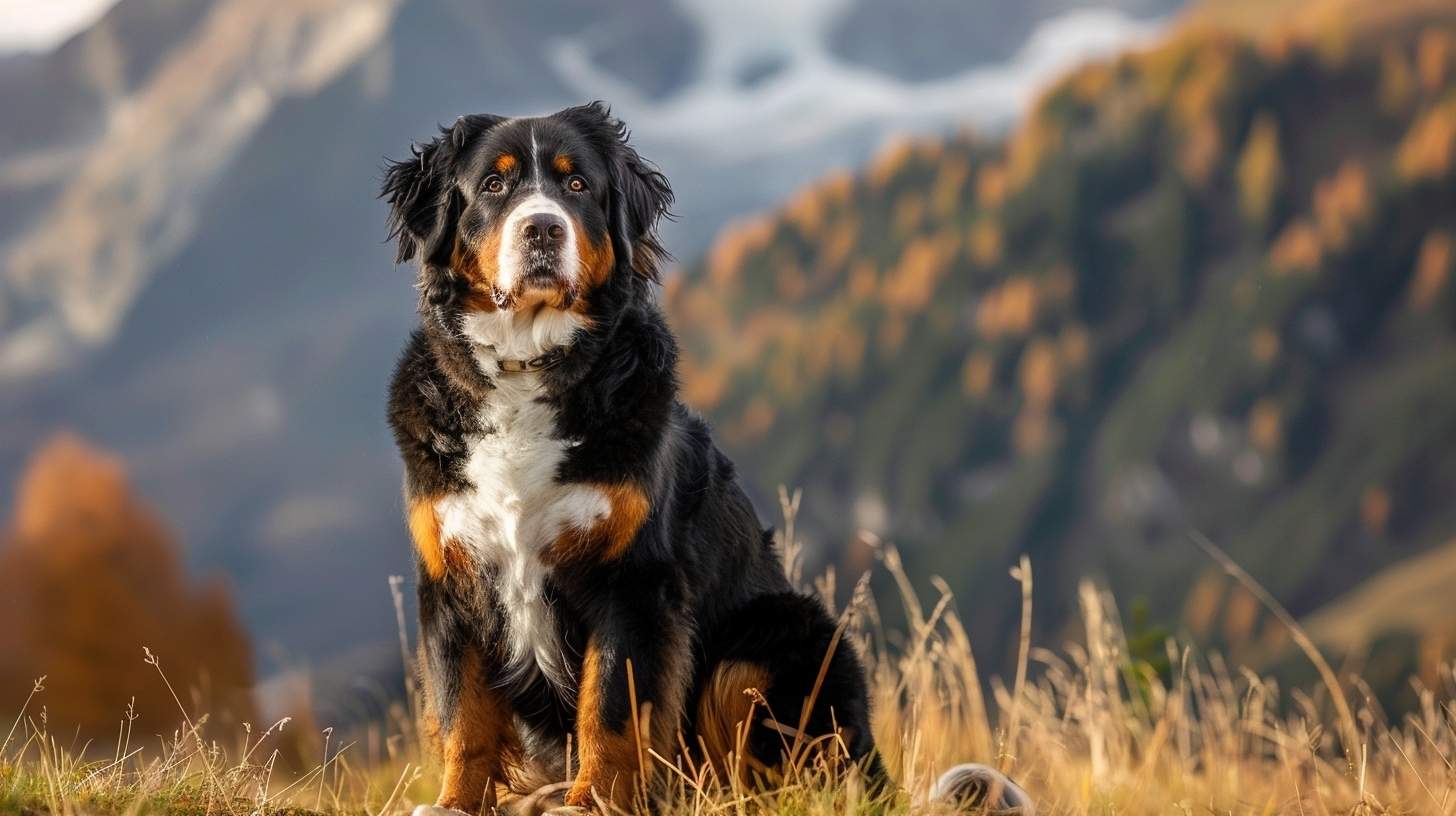
- ✅ Males: 80-115 lbs, Females: 70-95 lbs – large, powerful, and strikingly beautiful with a tricolor coat
- ✅ Moderate exercise needs – 60-90 minutes daily – more manageable than many large working breeds
- ✅ Highly trainable and eager to please – responds beautifully to gentle, consistent positive reinforcement
- ⚠️ Lifespan is only 7-10 years – one of the shortest of any recognized breed, a reality every prospective owner must accept
- ⚠️ Cancer is the leading cause of death in the breed – affecting up to 50% of Berners, far above the average for large dogs
- ⚠️ Bloat (GDV) is a significant risk in this deep-chested breed – emergency planning is essential
- ⚠️ The thick double coat produces very heavy seasonal shedding – daily brushing during coat blows is necessary
- ❌ Do NOT acquire a Bernese Mountain Dog without accepting the short lifespan – emotional and financial preparation for early loss is part of responsible ownership
- ❌ Do NOT skip orthopedic health testing on both parents – hip and elbow dysplasia rates are high in the breed
- This article draws on breed standards from the Bernese Mountain Dog Club of America (BMDCA) and the Schweizerischer Klub fur Berner Sennenhunde (SKG), health research from the BMDCA Health Committee and the Berner-Garde Foundation, and clinical guidance from veterinary oncologists and orthopaedic specialists with expertise in large Swiss mountain breed health.
- Last Updated: May 2026
What Kind of Dog Is a Bernese Mountain Dog?
Swiss farmers developed the Bernese Mountain Dog – known in Switzerland as the Berner Sennenhund – in the Alpine regions of Switzerland over centuries of farm work. While farmers used the other Swiss breeds (Greater Swiss Mountain Dog, Appenzeller, and Entlebuch) primarily for herding and droving, they specifically valued the Bernese as a draft dog. Its job involved pulling carts loaded with dairy products, cheese, and farm goods across the mountain terrain around the city of Bern.
The breed nearly went extinct in the late 19th century as agricultural mechanization reduced the need for draft dogs. A Bernese breeder named Franz Schertenleib located remaining examples of the breed on remote Swiss farms and began the revival that produced the modern Bernese. Swiss cynologist Albert Heim formally described and standardized the breed in 1902, and breeders founded the Berner Sennenhund Club in 1907.
The Bernese arrived in the United States in the 1920s, and the AKC granted recognition in 1937. Its combination of striking tricolor beauty, gentle temperament, and devoted family loyalty has made it one of the most beloved large breeds globally. However, its health challenges – particularly its disproportionately high cancer rate and short lifespan – have also made it the subject of intensive breed health research.
At a Glance: Bernese Mountain Dog Quick Reference
| Category | Details |
|---|---|
| AKC group | Working Group |
| Origin | Bern region, Switzerland |
| Male height | 25-27.5 inches |
| Female height | 23-26 inches |
| Male weight | 80-115 lbs |
| Female weight | 70-95 lbs |
| Lifespan | 7-10 years |
| Energy level | Moderate |
| Exercise needed | 60-90 minutes per day |
| Grooming | High – double coat, heavy seasonal shedding |
| Shedding | Very high – two annual coat blows |
| Trainability | Excellent – gentle and eager to please |
| Good with children | Exceptional |
| Good with other dogs | Excellent |
| Good with cats | Generally yes with socialization |
| Good with strangers | Friendly and welcoming |
| Cancer risk | Very high – leading cause of death |
| Bloat risk | High – deep-chested breed |
| Hip/elbow dysplasia risk | High – OFA screening essential |
| First-time owner suitable | Yes – with realistic health expectations |
Bernese Mountain Dog Temperament: What to Expect Living With One
The Gentle Giant of Swiss Origin
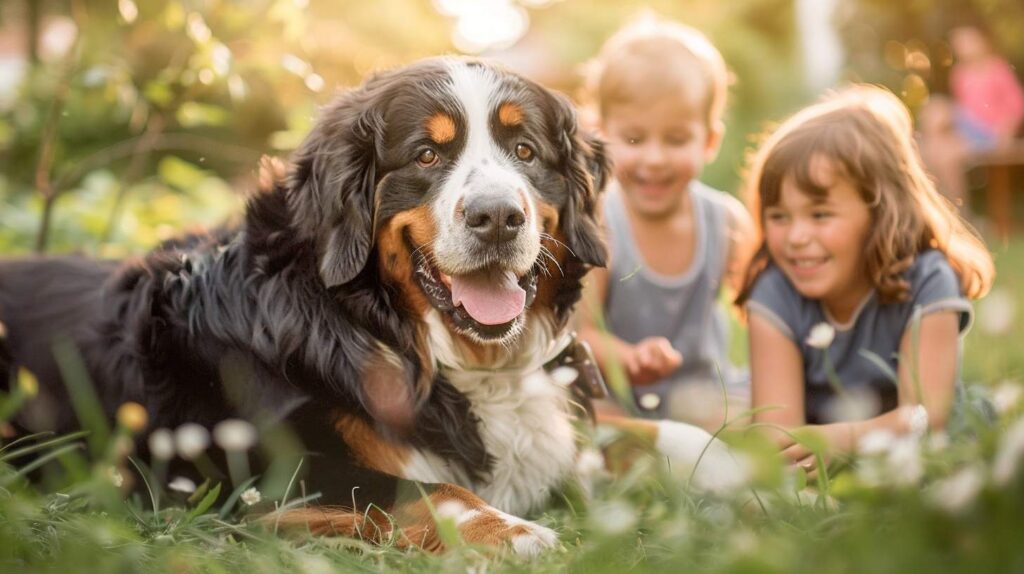
The Bernese Mountain Dog’s temperament is one of the most consistently gentle in the large breed world. Swiss farmers bred the Bernese to work alongside farm families in the Alps – pulling carts, driving cattle, and serving as watchdogs. Consequently, the breed developed an extraordinarily even disposition: calm enough to earn trust around children and livestock, alert enough to notice intrusions, and devoted enough to remain reliably close to its family throughout the day.
A well-bred Bernese is not excitable, reactive, or sharply guarding. It observes new situations thoughtfully, warms to strangers at its own pace, and manages its considerable physical size with a self-awareness that owners frequently find remarkable. A Bernese crossing a crowded room navigates around furniture, children, and small animals with careful deliberateness rather than the careless bulk one might expect from a 100-pound dog.
Devotion and Sensitivity
Bernese Mountain Dogs form deep bonds with their family and show particular sensitivity to the emotional environment around them. They pick up on tension, sadness, and stress with the attentiveness of a breed that spent centuries reading the emotional states of farm families in isolated mountain communities. This emotional sensitivity makes them naturally therapeutic – indeed, many owners certify their Berners as therapy dogs. It also means they respond strongly to household conflict and stress in ways that more emotionally resilient breeds do not.
Furthermore, Berners tend to bond with all family members rather than selecting a single primary person. This characteristic contributes to their reputation as family dogs in the most complete sense of the term.
Patience With Children
The Bernese Mountain Dog’s patience with children is exceptional. Their calm, steady nature means they tolerate the unpredictable behavior of young children with equanimity. Their gentle disposition means they rarely show irritation even under provocation. The practical consideration is size – a Bernese puppy that has not yet learned body awareness can knock over a toddler simply by turning around. Adult Berners are typically quite careful. However, supervision with very young children during the boisterous puppy phase remains important.
The Slow Maturation
Bernese Mountain Dogs mature slowly – both physically and mentally. Most dogs do not reach full behavioral maturity until 2-3 years of age. The puppy phase, combined with a large and still-growing body, creates a dog that is simultaneously gentle in temperament and physically overwhelming in its enthusiasm. Therefore, patient and consistent training from puppyhood is essential to establishing the impulse control that makes an adult Bernese the composed, reliable companion the breed is known for.
The Cancer Crisis: The Most Important Breed Health Topic
The Scale of the Problem
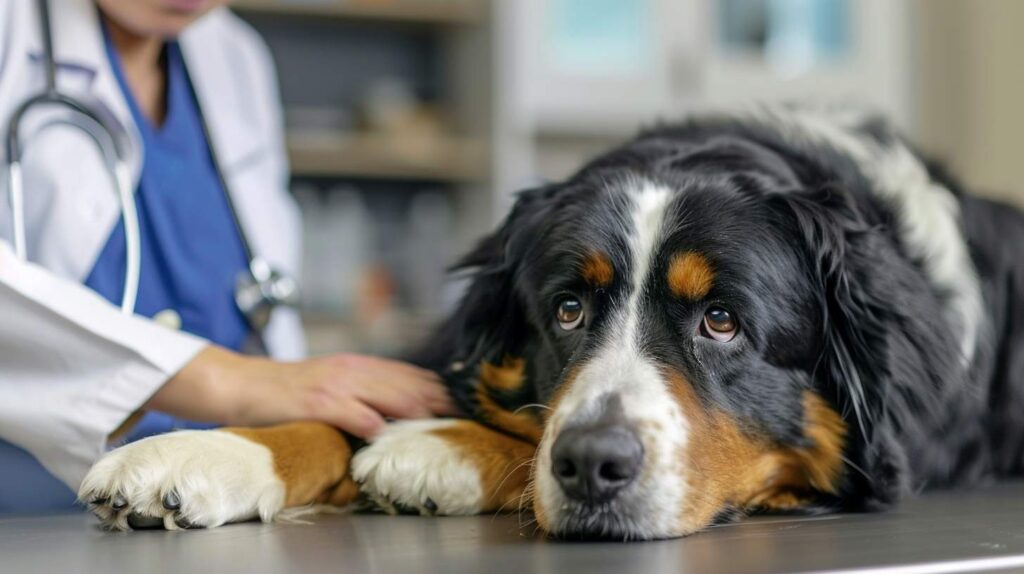
Cancer is the leading cause of death in Bernese Mountain Dogs, and its prevalence in the breed is extraordinary. Studies from the Berner-Garde Foundation – a Bernese health registry with data on tens of thousands of dogs – consistently show that approximately 50% of Bernese Mountain Dogs die of cancer-related causes. This rate far exceeds that of most other breeds and represents the single most significant health challenge facing the Bernese.
The most common cancer types in Berners include:
| Cancer Type | Notes |
|---|---|
| Histiocytic sarcoma | Most breed-specific – occurs at uniquely high rates in Berners |
| Malignant histiocytosis | Aggressive systemic form – rapid progression |
| Osteosarcoma | Bone cancer – affects large breeds at elevated rates |
| Lymphoma | Treatable in many cases with chemotherapy |
| Mast cell tumors | Variable malignancy – biopsy all new masses |
Histiocytic Sarcoma: The Berner’s Unique Cancer
Histiocytic sarcoma – particularly the aggressive systemic form called malignant histiocytosis – occurs in Bernese Mountain Dogs at rates that are extraordinary even compared to other cancer-prone breeds. It can arise in multiple organ systems simultaneously, progresses rapidly, and carries a poor prognosis even with treatment. Additionally, it is the most common cause of cancer death in the breed and stands as the focus of significant ongoing research.
The Berner-Garde Foundation and BMDCA Health Committee actively fund and promote research into genetic testing for cancer predisposition. As of 2026, no reliable predictive genetic test for histiocytic sarcoma exists – but early detection through regular veterinary examinations and prompt biopsy of any new masses represents the most effective current approach.
What Owners Can Do
| Action | Purpose |
|---|---|
| Bi-annual veterinary examinations from age 5 | Early detection improves treatment outcomes |
| Prompt biopsy of any new lump or mass | Histiocytic sarcoma can appear rapidly – never watch and wait |
| Regular blood panels from age 4 | Identifies internal changes before outward signs |
| Pet insurance from puppyhood | Cancer treatment can cost $5,000-20,000+ |
| Awareness of early signs | Lethargy, lameness, swelling, unexplained weight loss |
Bloat (GDV): The Second Emergency Planning Priority
Like Great Danes, Rottweilers, and other deep-chested large breeds, Bernese Mountain Dogs carry significant bloat risk. Gastric dilatation-volvulus (GDV) occurs when the stomach fills with gas and rotates on its axis, cutting off blood supply. Without emergency surgery, it is fatal within hours.
| Bloat Prevention Measure | Implementation |
|---|---|
| Two smaller meals daily instead of one | Reduces stomach distension per feeding |
| No exercise within 60 minutes of meals | Documented risk reduction |
| Slow-feeder bowl | Reduces rapid air ingestion during eating |
| Discuss prophylactic gastropexy with vet | Surgical prevention – stomach tacked to prevent rotation |
| Know nearest 24-hour emergency vet | Minutes matter – pre-plan before it happens |
Signs of bloat – distended abdomen, unproductive retching, restlessness, drooling – require immediate emergency veterinary care.
Orthopedic Health: The Growing Dog Priority
Hip and Elbow Dysplasia
Hip and elbow dysplasia occur at elevated rates in Bernese Mountain Dogs. Both conditions result from abnormal joint development that causes pain, reduced mobility, and progressive arthritis. Buyers should request OFA hip and elbow certificates for both parents before purchasing, as OFA evaluation of both parents represents the minimum standard responsible breeders follow.
Giant Breed Puppy Management
The rapid growth of a Bernese puppy creates joint vulnerability during the first 18-24 months. Managing this period appropriately reduces the risk of growth-related orthopedic problems significantly.
| Management Requirement | Specification |
|---|---|
| Diet | Large or giant breed puppy formula only – standard puppy food promotes too-rapid growth |
| Exercise | No high-impact jumping or running on hard surfaces until 18 months |
| Stair climbing | Limit – carry the puppy on stairs when possible |
| Body condition | Lean – do not allow a growing Berner to become overweight |
Grooming: Managing the Tricolor Double Coat
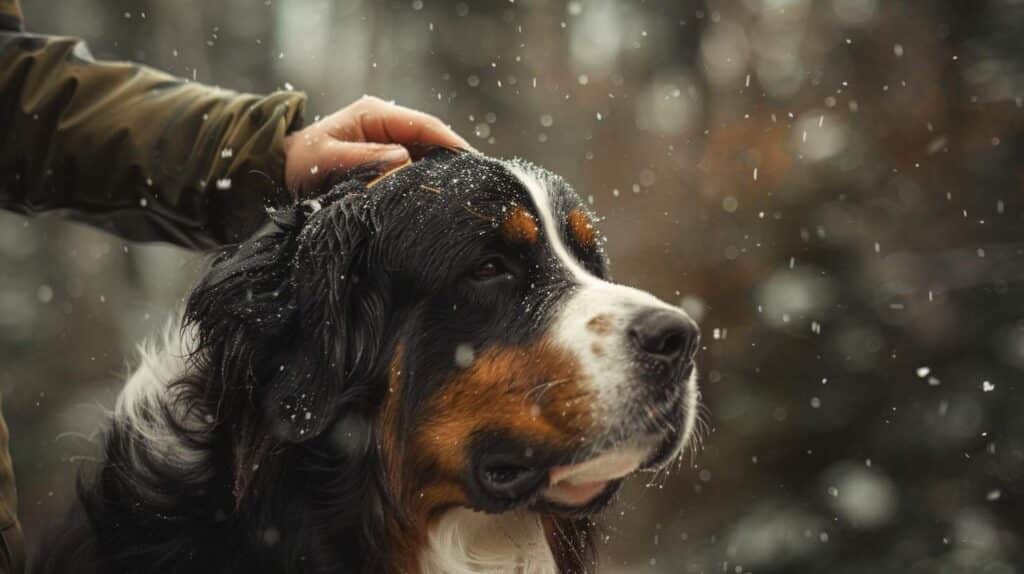
The Bernese Mountain Dog’s striking tricolor coat – jet black body, white chest blaze and muzzle, rich rust markings on face and legs – is one of the breed’s most beautiful features and one of its most demanding practical characteristics.
| Grooming Task | Frequency | Notes |
|---|---|---|
| Brushing (regular periods) | 3-4 times per week | Slicker brush and undercoat rake |
| Brushing (coat blow periods) | Daily | Spring and autumn blow – volume is extraordinary |
| Bathing | Every 6-8 weeks | Large breed bathing requires planning – use a walk-in shower or outdoor setup |
| Ear cleaning | Every 2 weeks | Floppy ears reduce airflow – infection risk |
| Nail trimming | Every 3-4 weeks | Large nails require sturdy clippers or a grinder |
| Teeth brushing | 3-5 times per week | Large breed dental maintenance |
| Paw pad inspection | Weekly | Working breed paw care – check for cracks and debris |
The Coat Blow Reality
Twice per year, a Bernese loses most of its undercoat over a 3-4 week period. The volume of shed hair during a coat blow is genuinely extraordinary – experienced Berner owners describe filling bags with shed fur daily. Daily brushing during coat blow periods is not optional. It prevents the dense undercoat from matting against the skin and dramatically reduces indoor hair accumulation.
Exercise: Moderate Needs With Puppy Caution
Adult Bernese Mountain Dogs need 60-90 minutes of moderate exercise daily. They are not high-drive working dogs that require intense activity – their pace is measured and enduring rather than explosive. They particularly enjoy outdoor activities in cool weather, which suits their Alpine heritage and double coat perfectly.
| Exercise Type | Suitability | Notes |
|---|---|---|
| Hiking and trail walking | Excellent | Ideal activity – mental and physical |
| Carting and draft work | Excellent – breed heritage | Specialized equipment needed |
| Swimming | Good | Low-impact – excellent for joint health |
| Fetch | Good with moderation | Avoid repetitive jumping retrieves |
| Agility | Moderate – suitable for conditioned adults | Not recommended during growth phase |
| Running in heat | Avoid | Double coat – heat sensitive above 70°F |
Heat Sensitivity
The Bernese double coat provides excellent insulation against cold but limited protection against heat. Therefore, Berners in warm climates require exercise in early morning or after sunset, access to shade and water at all times, and air-conditioned indoor living during hot weather. They are genuinely not suited to outdoor-only living in warm climates.
Health: Complete Condition Overview
| Health Condition | Prevalence | Signs to Watch For | Action |
|---|---|---|---|
| Cancer (all types) | Very high – ~50% of deaths | Lumps, weight loss, lethargy, lameness | Bi-annual vet exams from age 5 – biopsy promptly |
| Histiocytic sarcoma | Very high – breed-specific | Rapid swelling, lameness, internal organ signs | Immediate vet evaluation |
| Hip dysplasia | High | Stiffness, reluctance to exercise | OFA on both parents – annual vet evaluation |
| Elbow dysplasia | High | Foreleg lameness | OFA on both parents |
| Bloat (GDV) | High | Distended abdomen, retching | Emergency vet immediately |
| Degenerative myelopathy | Moderate | Progressive rear limb weakness | DNA testing available |
| Progressive retinal atrophy | Moderate | Night blindness | Annual eye exam |
| Hypothyroidism | Moderate | Weight gain, lethargy, coat changes | Annual thyroid panel |
| von Willebrand disease | Low-moderate | Excessive bleeding | DNA testing |
The Lifespan Reality: Preparing for Loss
The 7-10 year average lifespan of the Bernese Mountain Dog is one of the most discussed topics in the breed community. Many Berners die at 6-8 years – young enough that owners feel the relationship ended too soon. This reality does not diminish the value of the relationship. Bernese Mountain Dog owners consistently describe their dogs as among the most deeply rewarding companions they have ever known.
Nevertheless, this reality demands honest acknowledgment before acquisition. The financial, emotional, and practical preparation for early loss is part of responsible Bernese ownership. Specifically, pet insurance from puppyhood, awareness of cancer signs, and realistic emotional preparation for the possibility of significant illness before age 10 are all appropriate parts of planning.
Is a Bernese Mountain Dog Right for You?
Owners Who Succeed With Bernese Mountain Dogs
Bernese Mountain Dogs thrive with families that want a large, gentle, deeply loyal companion. They suit homes with space for a large dog to move comfortably. Additionally, owners who can manage significant grooming during seasonal shedding find the breed very rewarding. Moderate or cool climates suit them best. Above all, this breed thrives with anyone who approaches its health realities and shortened lifespan with honest preparation and anyone who wants a dog equally devoted to all family members.
Households That Struggle With Bernese Mountain Dogs
Bernese Mountain Dogs are consistently challenging for owners in hot climates without reliable air conditioning. They also struggle in households that are not financially and emotionally prepared for a potential cancer diagnosis before age 10. Owners who cannot manage the very significant grooming demands of a large double-coated breed, and anyone who wants a low-maintenance companion, will find a different breed suits them better.
New puppy? Find a name that fits their personality.
Browse 600+ dog names by gender and personality type — playful, calm, bold, elegant, funny or mysterious.
Try Pet Name FinderFrequently Asked Questions
Bernese Mountain Dog Health and Lifespan
Why do Bernese Mountain Dogs have such short lifespans? The Bernese Mountain Dog’s short lifespan results primarily from its disproportionately high cancer rate – particularly histiocytic sarcoma, which is rare in most breeds but common in Berners. The physiological demands of sustaining a large body mass also contribute to accelerated aging, as researchers observe across giant breeds generally. Research into the genetic basis of cancer in the breed continues through the Berner-Garde Foundation and BMDCA Health Committee.
What is histiocytic sarcoma? Histiocytic sarcoma is a cancer arising from histiocytes – immune system cells throughout the body. In Berners, it occurs at rates that are extraordinary compared to other breeds and can arise in bones, joints, the spleen, lungs, and central nervous system simultaneously. It progresses rapidly and offers limited treatment options compared to many other cancers. It is the most significant cancer health challenge in the breed and the focus of the most intensive ongoing research.
How much do Bernese Mountain Dogs shed? Enormously during the two annual coat blows. Year-round moderate shedding is manageable with regular brushing. However, during blow periods, the volume of shed fur requires daily brushing to prevent matting and indoor accumulation. Berner ownership means accepting that dog hair will be a permanent feature of household life.
Bernese Mountain Dog Temperament and Daily Life
Are Bernese Mountain Dogs good apartment dogs? With significant exercise commitment, they can adapt to apartment living. Their calm indoor temperament and moderate exercise needs make them less impractical in apartments than high-energy working breeds. The primary considerations are size – ensuring adequate indoor space – and heat sensitivity, which requires air conditioning during warm months.
Do Bernese Mountain Dogs drool? Less than some large breeds – they are not heavily jowled in the way Mastiffs or Saint Bernards are. Most Berners drool moderately after drinking, during excitement, and in heat. Owners in warm climates report more drooling due to increased panting.
Are Bernese Mountain Dogs good with cats? Generally yes with proper socialization. Their gentle nature and absence of strong prey drive make them more cat-compatible than many large breeds. Adult cats that owners introduce to a Berner puppy typically establish a comfortable relationship within a few weeks. Adult Berners that owners introduce to cats require a careful, gradual introduction over several days.
How much does a Bernese Mountain Dog eat? An active adult male Berner requires approximately 2,000-2,500 calories daily. Females require somewhat less. Feed a high-quality large breed adult formula in two meals daily. During the growth phase, use giant breed puppy formula only – standard puppy food promotes too-rapid growth and increases orthopedic disease risk.
Key Takeaways
- Cancer affects approximately 50% of Berners – bi-annual veterinary exams from age 5 and prompt biopsy of any new mass are essential
- The 7-10 year lifespan demands honest emotional and financial preparation – pet insurance from puppyhood is strongly recommended
- Histiocytic sarcoma is the breed’s most distinctive health challenge – no genetic test yet exists, but early detection through regular exams is the best current tool
- Bloat is a life-threatening emergency – know the signs and pre-plan the nearest emergency vet
- OFA hip and elbow certification on both parents is a minimum requirement – dysplasia rates are high
- Giant breed puppy food only during growth – standard puppy food increases orthopedic disease risk
- Daily brushing during coat blows is essential – the volume of shed fur is extraordinary
- The Berner temperament is among the most gentle and reliable of any large breed – the health challenges are the price of a remarkable companion
This article is for informational purposes only. Breed characteristics represent general tendencies and do not predict the behavior or health of any individual dog. Always consult a veterinarian for health advice. Bloat is a life-threatening emergency – seek immediate veterinary care if signs appear.