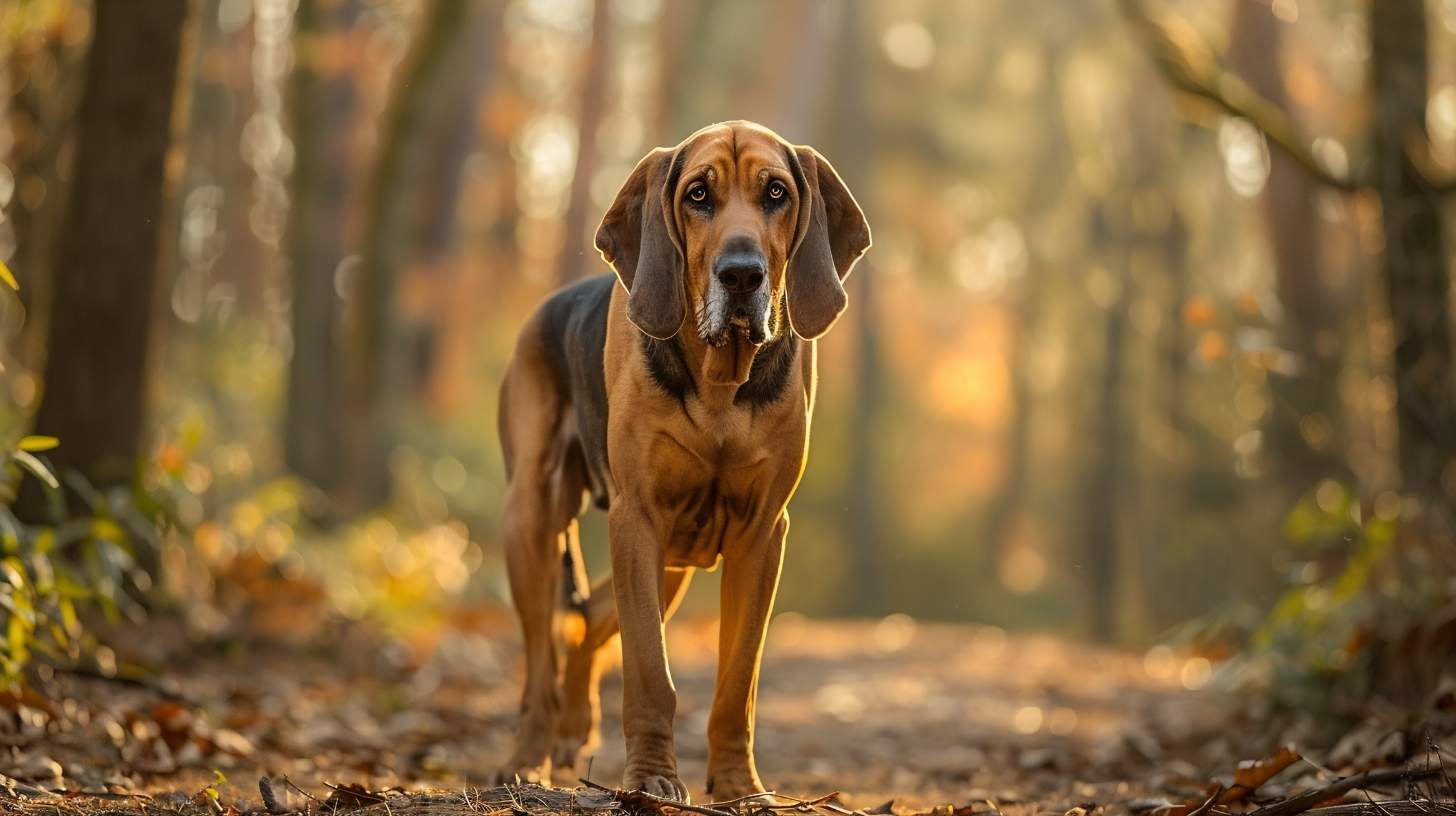
Bloodhound: Complete Breed Guide – Temperament, Care, Health & More (2026)
- 🐕 QUICK ANSWER: BLOODHOUND BREED GUIDE
- ✅ The Bloodhound has the most powerful nose of any animal on Earth – approximately 300 times more sensitive than a human’s, with over 300 million olfactory receptors
- ✅ Bloodhound-led trails are the only dog scent evidence admissible in US courts of law – the breed’s tracking accuracy is legally recognized
- ✅ Males: 90-130 lbs, Females: 80-100 lbs – large, powerful, and built for sustained trailing over enormous distances
- ✅ Gentle, affectionate, and patient – one of the most tolerant and even-tempered of all large breeds
- ✅ The deep, melodious Bloodhound voice is one of the most remarkable sounds in the dog world
- ⚠️ Ear infections are near-universal without weekly cleaning – the long pendulous ears trap moisture with every step
- ⚠️ Bloat is the leading cause of death in the breed – every Bloodhound owner must have emergency plans in place
- ⚠️ Extreme stubbornness when on a scent – a Bloodhound following a trail is completely unreachable and will follow it for miles regardless of hazards
- ⚠️ Skin fold management and jowl cleaning are daily necessities – neglected folds cause painful infections
- ❌ Do NOT trust a Bloodhound off-leash outside a securely fenced area – once the nose locks onto a trail, no recall command will work
- ❌ Do NOT skip daily jowl and fold cleaning – moisture and debris accumulate rapidly in the wrinkled skin and cause serious infections
- This article draws on breed standards from the American Kennel Club (AKC) and the American Bloodhound Club (ABC), health research from the ABC Health Committee, and clinical guidance from veterinary gastroenterologists and orthopaedic specialists with expertise in giant breed health.
- Last Updated: May 2026
What Kind of Dog Is a Bloodhound?
Monastic Origins in Belgium
The Bloodhound is one of the oldest purebred dogs in the world, and its history is inseparable from the monastic communities of medieval Belgium. Specifically, the breed’s ancestors – large scent hounds brought to Europe from the Byzantine Empire and the Middle East – were refined and standardized by monks at the Abbey of Saint-Hubert in the Ardennes forest of what is now Belgium. Saint Hubert was the patron saint of hunters, and the monks maintained kennels of tracking hounds that became legendary throughout Europe. Monks called these dogs Chiens de Saint-Hubert – St. Hubert Hounds.
Notably, the term “Bloodhound” has nothing to do with blood or violence. Instead, it refers to the breed’s status as a “blooded hound” – a pure-blooded, aristocratic animal of noble lineage. The name reflects the medieval distinction between carefully maintained purebred noble hunting hounds and common working dogs.
From England to Law Enforcement
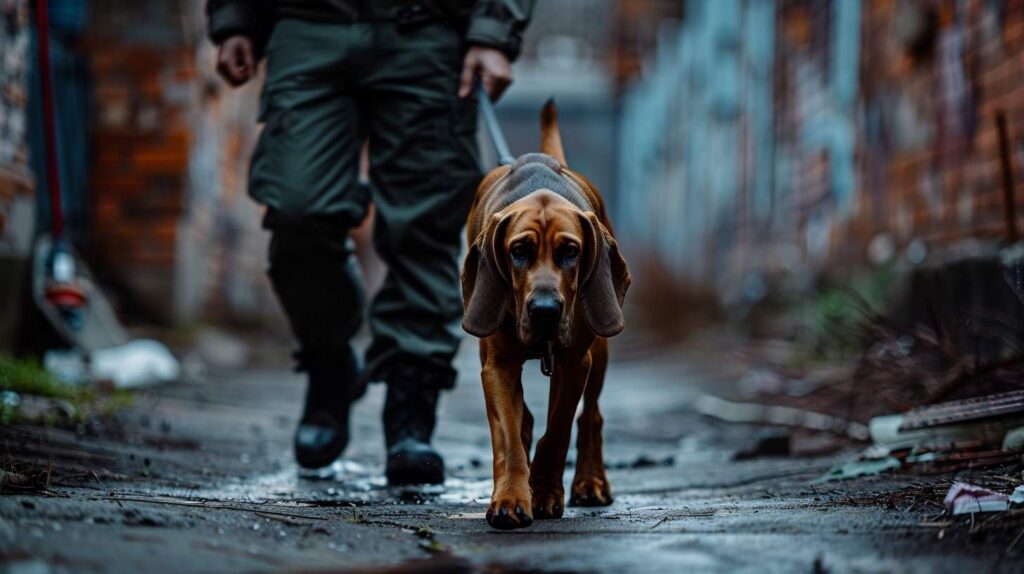
Furthermore, William the Conqueror brought St. Hubert Hounds to England in 1066, and English breeders developed their own version that eventually became the modern Bloodhound. English nobility treasured these dogs for deer and boar hunting, and their extraordinary tracking ability led naturally to their use in tracking human fugitives – a role that would define the breed’s modern identity.
By the 19th century, law enforcement in both Britain and the United States routinely used Bloodhounds for tracking. Additionally, their ability to follow a scent trail days old, across varied terrain, to the precise individual who left it, produced a remarkable legal distinction. Specifically, US courts established that Bloodhound trailing evidence is admissible in courts of law – the only scent evidence from any animal to receive this legal status. Courts granted this recognition based on documented cases where Bloodhound-led trails had led directly and accurately to convicted criminals.
A Documented and Measurable Capability
Indeed, the Bloodhound’s tracking capability is not mythology – it is documented and measurable. The breed has followed trails over 130 miles long. Furthermore, it has tracked individuals through urban environments, across water, and in conditions that defeat every other scent-working breed. Consequently, several Bloodhounds have received formal law enforcement commendations for their role in locating missing persons.

At a Glance: Bloodhound Quick Reference
| Category | Details |
|---|---|
| AKC group | Hound Group |
| Origin | Belgium / England – Abbey of Saint-Hubert, medieval period |
| Male height | 25-27 inches |
| Male weight | 90-130 lbs |
| Female height | 23-25 inches |
| Female weight | 80-100 lbs |
| Lifespan | 10-12 years |
| Energy level | Moderate |
| Exercise needed | 45-60 minutes per day |
| Grooming | Low coat – high fold and jowl maintenance |
| Shedding | Moderate |
| Trainability | Moderate – highly intelligent but scent-driven |
| Good with children | Excellent |
| Good with other dogs | Excellent |
| Good with cats | Variable – prey drive present |
| Good with strangers | Friendly |
| Bloat risk | Very high – leading cause of death |
| Ear infection risk | Very high |
| Recall reliability | Essentially zero when on a scent trail |
| Apartment suitable | No – size and exercise needs |
| First-time owner suitable | Possible with realistic expectations |
The Bloodhound Nose: The Most Powerful Scenting Instrument on Earth
The Numbers
| Species | Olfactory Receptors | Relative to Human |
|---|---|---|
| Human | 6 million | 1x |
| Dog (average) | 150-300 million | 25-50x |
| Bloodhound | 300+ million | 50x+ |
Moreover, the Bloodhound’s scenting capability is not merely quantitative – its nasal anatomy is specifically optimized for scent capture. The long, pendulous ears create air currents that sweep ground-level scent upward toward the nose when the dog trots with its head low. Furthermore, the loose, wrinkled skin around the face and neck traps scent particles and holds them near the nose during tracking. Even the Bloodhound’s drool serves a scenting function – moisture on the ground enhances scent molecule vaporization.
Legal Admissibility
The US legal precedent for Bloodhound trailing evidence dates to 1895 in the case of State v. Dickerson in West Virginia, and courts have affirmed it in numerous subsequent cases. For trailing evidence to be admissible, the dog must be a certified Bloodhound, the handler must be trained, the chain of scent custody must be documented, and the trailing must follow accepted protocols. Notably, no other breed’s scent work has achieved this legal recognition.
Bloodhound Temperament: What to Expect
Gentle Giant
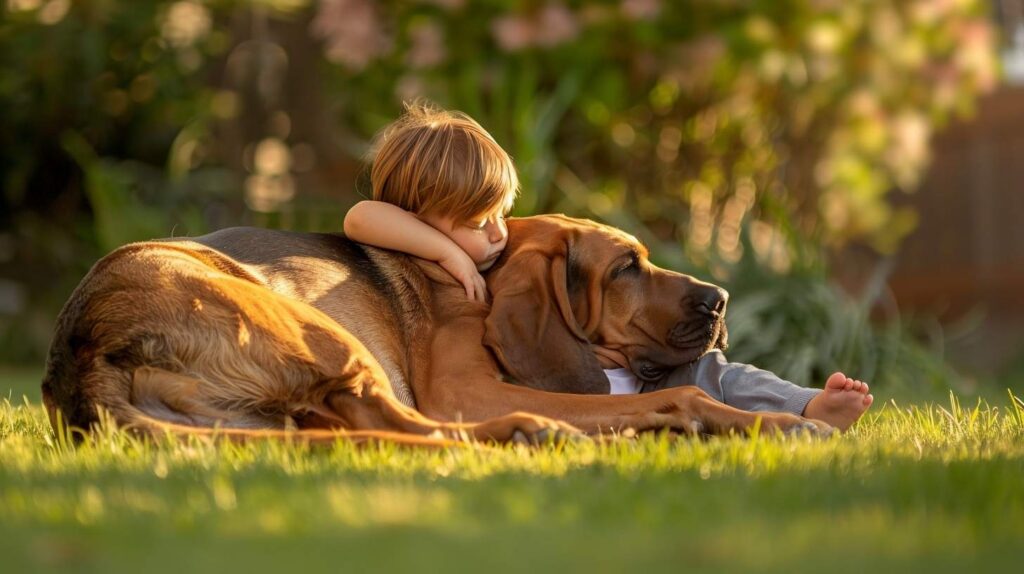
The Bloodhound’s temperament stands in stark contrast to its formidable tracking capability. Indeed, this is not a fierce, aggressive working dog – it is a profoundly gentle, patient, and affectionate animal that happens to possess extraordinary olfactory capability. Within the household, Bloodhounds are warm, devoted, and notably tolerant – they endure the unpredictable behavior of children with patience, accept other animals with equanimity, and greet strangers with friendly curiosity.
Breeders never selected the Bloodhound for aggression or protection – they selected it for its nose and its endurance on a trail. Consequently, the result is a large, powerful dog with the temperament of a gentle companion.
The Scent Obsession
The Bloodhound’s relationship with scent is not simply a strong drive – it is a consuming orientation that overrides all other behavior when activated. Specifically, a Bloodhound that has located an interesting scent trail is not a dog that owners can distract, recall, or redirect by normal means. It will follow that trail with focused determination across whatever terrain lies before it – roads, waterways, fences, traffic – until the trail ends or someone physically stops the dog.
Furthermore, this characteristic makes off-leash freedom in unfenced areas genuinely dangerous for Bloodhounds regardless of training level. Even professional trailing Bloodhounds always work on a long line held by a handler. The only difference between a trained tracking Bloodhound and an untrained pet following a random scent is that the trained dog attaches to a handler.
Stubbornness and Independence
In general, Bloodhounds are among the more stubborn dogs when not engaged with scent. Like the Basset Hound – their closest relative – they apply independent judgment to whether commands merit compliance when scent is not the immediate focus. However, this stubbornness is not aggressive or dominant – it is simply the expression of a breed that spent centuries operating independently on a trail without handler direction.
The Wrinkles, Jowls, and Drool Reality
Daily Skin Management
The Bloodhound’s characteristic loose, heavily wrinkled skin and pendulous jowls – beautiful and distinctive in appearance – are significant sources of health problems without consistent daily management. Specifically, the combination of moisture, debris, and limited air circulation in these folds creates ideal conditions for bacterial growth.
| Area | Cleaning Frequency | Risk If Neglected |
|---|---|---|
| Facial wrinkles | Daily | Moisture accumulation – dermatitis and infection |
| Jowls and lip folds | Daily | Food, water, and saliva accumulation – chronic infection |
| Neck folds | Every 2-3 days | Moisture trapping – skin fold dermatitis |
| Around eyes | Daily | Discharge accumulation – irritation and infection |
The Drool Reality
Bloodhounds drool significantly. The long jowls and loose lips that optimize scent trapping produce constant saliva accumulation that distributes onto furniture, clothing, walls, and anything within reaching distance. Consequently, experienced Bloodhound owners keep dedicated “slobber cloths” throughout the home. This is not an occasional phenomenon – it is a permanent feature of living with this breed.
Ear Care: The Most Important Daily Task
Why Ear Infections Are Near-Universal
The Bloodhound’s extraordinarily long, pendulous ears create perfect conditions for ear infections. They hang below the head, cover the ear canal completely, eliminate airflow, collect moisture from the ground during trailing, and accumulate debris continuously. Therefore, weekly cleaning is the most important preventive health task for this breed – more important even than coat care.
| Ear Care Task | Frequency | Notes |
|---|---|---|
| Full ear cleaning | Weekly | Veterinarian-recommended solution |
| Quick ear inspection | Daily | Check for early redness or odor |
| Ear lift during feeding | Every meal | Ears drag in food and water bowl |
| Post-walk debris check | After every walk | Ears collect environmental debris |
| Ear drying after bathing | After every bath | Complete drying essential |
Health: Common Conditions in Bloodhounds
Bloat: The Primary Health Emergency
Notably, bloat is the leading cause of death in Bloodhounds. Their deep, narrow chest creates among the highest bloat risk of any breed. Consequently, every Bloodhound owner must pre-plan the nearest 24-hour emergency veterinary clinic and discuss prophylactic gastropexy with their veterinarian before it is needed.
Health Conditions Overview
| Health Condition | Prevalence | Signs to Watch For | Action |
|---|---|---|---|
| Bloat (GDV) | Very high – leading cause of death | Distended abdomen, retching, restlessness, collapse | Emergency vet immediately |
| Hip dysplasia | High | Stiffness, abnormal gait | OFA evaluation on both parents |
| Ear infections | Very high | Head shaking, odor, scratching | Weekly cleaning – vet if infection develops |
| Skin fold dermatitis | High | Redness, odor in folds and jowls | Daily cleaning |
| Elbow dysplasia | Moderate | Foreleg lameness | OFA elbow evaluation |
| Hypothyroidism | Moderate | Weight gain, lethargy, coat changes | Annual thyroid panel |
| Entropion | Moderate | Eye squinting, discharge | Surgical correction |
| Ectropion | Moderate | Drooping lower lid, chronic eye discharge | Management or surgery |
| Osteosarcoma | Moderate – large breed | Limb pain and swelling | Prompt biopsy |
| Cardiac disease | Low-moderate | Exercise intolerance, murmur | Annual cardiac exam after age 5 |
The Short Lifespan Reality
Unfortunately, Bloodhounds typically live 10-12 years – shorter than many large breeds. Bloat, osteosarcoma, and cardiac disease all contribute to this compressed lifespan. Fortunately, prophylactic gastropexy significantly reduces bloat mortality risk. Additionally, annual veterinary examinations from middle age onwards support early detection of other conditions.
Exercise: Moderate Needs, Scent Management
Overall, Bloodhounds need 45-60 minutes of daily exercise – moderate for their size. However, all outdoor exercise must occur on-leash or within genuinely secure fencing without exception.
| Exercise Type | Suitability | Notes |
|---|---|---|
| On-leash walks (varied terrain) | Excellent | Mental engagement from scent-rich environments |
| Tracking and trailing work | Exceptional | True expression of breed function |
| Off-leash in securely fenced area | Good | Must be genuinely escape-proof |
| Swimming | Good | Low-impact exercise – most enjoy water |
| Long-line trailing | Excellent | Structured scent work with safety |
| Off-leash in unfenced areas | Never | Trail obsession makes this genuinely dangerous |
Training: Working With the World’s Best Nose
Indeed, Bloodhounds are intelligent but apply that intelligence to scent rather than handler compliance. In practice, training that competes with interesting scent requires genuinely high-value rewards and realistic expectations. Specifically, formal tracking training channels the nose productively and builds a working relationship that makes all other training more effective.
| Training Priority | Why It Matters |
|---|---|
| On-leash manners | Pulling is extreme when following scent |
| Formal tracking training | Channels the nose productively and safely |
| Recall in scent-free environments | Builds the best possible recall for non-scent situations |
| Leave it | Prevents following dangerous scent trails into hazards |
| Quiet command | The Bloodhound voice carries far and long |
Is a Bloodhound Right for You?
Owners Who Succeed With Bloodhounds
Bloodhounds thrive with active owners who appreciate the breed’s unique scenting capability, with families in rural or suburban settings with securely fenced outdoor space, and with owners committed to daily jowl and fold cleaning. Furthermore, anyone who approaches the breed’s stubbornness and scent obsession as interesting characteristics rather than frustrating ones will find the Bloodhound deeply rewarding. Above all, owners who plan for bloat as a genuine lifetime health management priority keep their dogs safest.
Households That Struggle With Bloodhounds
In contrast, Bloodhounds are consistently challenging for owners who want a reliable off-leash companion, for anyone not prepared for significant daily drool management, for apartment or urban residents without fenced outdoor space, and for anyone who does not approach bloat prevention as a daily practice.
New puppy? Find a name that fits their personality.
Browse 600+ dog names by gender and personality type — playful, calm, bold, elegant, funny or mysterious.
Try Pet Name FinderFrequently Asked Questions
Bloodhound History and Identity
Why is Bloodhound tracking evidence admissible in court? Specifically, US courts established this precedent beginning in 1895, recognizing that a properly trained Bloodhound’s ability to follow a specific individual’s scent with documented accuracy justified treating trailing evidence similarly to other forensic evidence. The admissibility requires certification of the dog, training of the handler, documentation of chain of scent custody, and adherence to established trailing protocols. No other animal’s scent evidence has received this legal recognition.
Why is the breed called “Bloodhound” if it doesn’t track blood? The name refers to “blooded” – meaning pure-blooded or of noble lineage – not to blood or violence. Specifically, the medieval distinction between carefully bred noble hunting hounds and common working dogs produced this terminology. A “bloodhound” was an aristocratic, pure-bred scent hound of documented lineage. The name has nothing to do with tracking blood trails.
Are Bloodhounds related to Basset Hounds? Yes – Basset Hounds are direct descendants of the St. Hubert Hound lineage that produced the modern Bloodhound. Specifically, French breeders developed the shorter-legged Basset type from the same foundation stock, selecting for a dog that moved more slowly so that hunters on foot could keep pace. Both breeds share the long ears, loose skin, drooping jowls, and exceptional nose that define the St. Hubert Hound heritage.
Bloodhound Care and Behavior
How far can a Bloodhound track? Documented trailing records exceed 130 miles in continuous trailing. Bloodhounds have followed trails more than 100 hours old, across varied terrain including urban environments and waterways. These represent the upper range of documented capability in optimal conditions. In everyday search and rescue work, however, they routinely outperform every other scent-working breed in aged trail conditions.
Do Bloodhounds make good family dogs? Yes – their temperament is genuinely excellent with families. They are patient with children, friendly with strangers, and good with other dogs. The practical challenges are their size and drool rather than temperament. Families that enjoy large, affectionate, somewhat messy dogs find Bloodhounds wonderful companions. However, families that want a tidy, quiet, easily managed dog should look elsewhere.
How much do Bloodhounds drool? Significantly – it is one of the defining practical realities of owning the breed. The long jowls and loose lips that optimize their scenting ability produce constant saliva accumulation that distributes widely throughout the home. Notably, many Bloodhound owners describe always carrying a cloth and accepting that walls, furniture, and clothing will carry the evidence regularly. This is not a problem to solve but a characteristic to accept.
Bloodhound Working Roles
Can a Bloodhound train for search and rescue? Yes – and they are among the most effective search and rescue dogs available for trailing missing persons. Their ability to follow a specific human scent over long distances, in aged trail conditions, and through environments that defeat other breeds makes them invaluable in missing person cases. Consequently, several working Bloodhounds in US search and rescue programs have received formal law enforcement recognition for their roles in locating missing individuals.
Key Takeaways
- Bloodhound trailing evidence is admissible in US courts – the only dog scent evidence with this legal status
- Bloat is the leading cause of death in the breed – prophylactic gastropexy and emergency planning are essential
- Daily jowl, fold, and ear cleaning are non-negotiable health maintenance tasks
- Off-leash freedom outside secure fencing is never safe – the scent obsession overrides all recall
- The “blood” in Bloodhound means noble lineage, not blood trails – medieval terminology for a purebred aristocratic hound
- The Abbey of Saint-Hubert in Belgium created the breed’s ancestors – William the Conqueror brought them to England in 1066
- Drool is permanent and significant – this is a characteristic to accept, not a problem to solve
- The long ears, loose skin, and even the drool all serve specific scent-trapping functions – every physical feature has a nose-related explanation
This article is for informational purposes only. Breed characteristics represent general tendencies and do not predict the behavior or health of any individual dog. Always consult a veterinarian for health advice. Bloat is a life-threatening emergency – seek immediate veterinary care if signs are observed.