Samoyed: Complete Breed Guide – Temperament, Care, Health & More (2026)
- 🐕 QUICK ANSWER: SAMOYED BREED GUIDE
- ✅ The Samoyed is one of the oldest and most genetically primitive dog breeds – a living link to the original domestic dog that co-evolved with Siberian nomads for thousands of years
- ✅ The “Samoyed smile” – a permanent upward curve of the lips – is a functional adaptation that prevented drool from freezing in Arctic temperatures
- ✅ Males: 45-65 lbs, Females: 35-50 lbs – medium-large, strong, and beautifully proportioned
- ✅ Gentle, friendly, and people-loving – one of the most broadly compatible and socially open spitz breeds
- ✅ The Samoyed’s white coat is one of the most spectacular in the dog world – and one of the most demanding to maintain
- ⚠️ The double coat sheds heavily year-round with two dramatic annual coat blows – daily brushing during blow periods is essential
- ⚠️ Separation anxiety is common – Samoyeds lived for thousands of years in close human contact and do not cope well with extended isolation
- ⚠️ Samoyed Hereditary Glomerulopathy (SHG) is a fatal kidney disease affecting male Samoyeds – DNA testing on breeding dogs is essential
- ⚠️ High prey drive and wandering tendency – recall is unreliable off-leash outside secure fencing
- ❌ Do NOT acquire a Samoyed if you are not prepared for the significant daily grooming commitment – a neglected Samoyed coat develops severe matting that causes skin pain
- ❌ Do NOT free-roam a Samoyed – their wandering drive and poor recall make traffic and loss a genuine risk
- This article draws on breed standards from the American Kennel Club (AKC) and the Samoyed Club of America (SCA), health research from the SCA Health Committee, and clinical guidance from veterinary nephrologists and cardiologists specializing in spitz and Arctic breed health.
- Last Updated: May 2026
What Kind of Dog Is a Samoyed?
Ancient Siberian Heritage
The Samoyed is one of the oldest dog breeds in the world and one of the most genetically primitive – meaning it diverged from the wolf ancestor earlier than most modern breeds and retains more ancient canine genetics than dogs with longer histories of selective breeding. DNA studies consistently place the Samoyed among the basal breeds alongside the Shiba Inu, Akita, Chow Chow, and a small group of other ancient breeds.
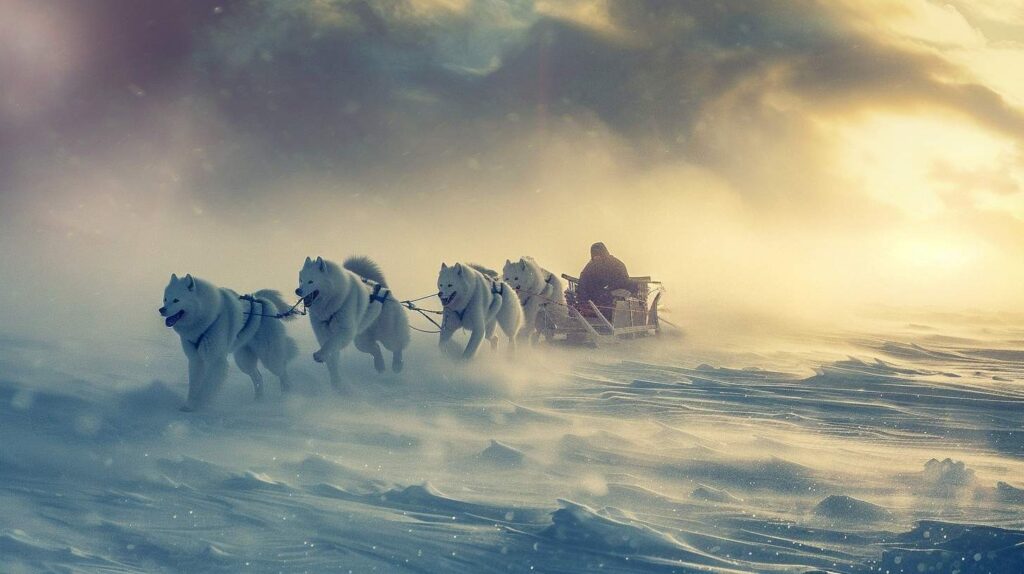
Its origins lie with the Samoyede people – nomadic reindeer herders who inhabited the vast tundra and forest regions of northwestern Siberia for thousands of years. The Samoyede and their dogs developed in complete interdependence: the dogs herded reindeer, hauled sleds, hunted large animals, and in the harshest Arctic nights, slept inside the nomads’ tents pressed against the bodies of children and elderly family members for mutual warmth. Consequently, this extraordinary intimacy over millennia produced the Samoyed’s most defining temperamental characteristic – a genuine and deep orientation toward people that is uncommon even among highly domesticated breeds.
Western Discovery and Royal Recognition
Russian explorers expanding eastward across Siberia from the 17th century onward first encountered the Samoyede people and their dogs. The name Samoyed – both for the people and their dogs – derives from the Russian interpretation of the Nenets people’s self-designation, meaning “true people.”
Western explorers then encountered Samoyeds in the late 19th century, when British explorer Robert Scott and Norwegian explorer Fridtjof Nansen used them for polar expeditions. Furthermore, Ernest Shackleton’s 1914 Endurance expedition also included Samoyeds. These polar exploration associations established the breed’s presence in British aristocratic circles – notably, Queen Alexandra received several Samoyeds as gifts, which brought the breed firmly into British show dog culture in the early 20th century.
From Polar Expeditions to Today
The AKC recognized the Samoyed in 1906, making it one of the earlier spitz breeds to gain American recognition. The breed has remained consistently popular since, with its extraordinary coat and warm temperament generating both genuine admirers and impulsive acquisitions that end in surrender when the grooming reality becomes clear.
At a Glance: Samoyed Quick Reference
| Category | Details |
|---|---|
| AKC group | Working Group |
| Origin | Siberia – Samoyede / Nenets people |
| Male height | 21-23.5 inches |
| Male weight | 45-65 lbs |
| Female height | 19-21 inches |
| Female weight | 35-50 lbs |
| Lifespan | 12-14 years |
| Energy level | Moderate to high |
| Exercise needed | 60-90 minutes per day |
| Grooming | Very high – daily brushing during coat blows |
| Shedding | Very high – year-round with dramatic seasonal blows |
| Trainability | Moderate – intelligent but independent |
| Good with children | Excellent |
| Good with other dogs | Excellent |
| Good with cats | Variable – prey drive present |
| Good with strangers | Very friendly |
| SHG risk | Moderate – male Samoyeds specifically |
| Separation anxiety risk | Moderate-high |
| Recall reliability | Low – never trust off-leash |
| Apartment suitable | Challenging – coat and exercise needs |
| First-time owner suitable | Possible with realistic grooming commitment |

The Samoyed Smile: Function Before Beauty
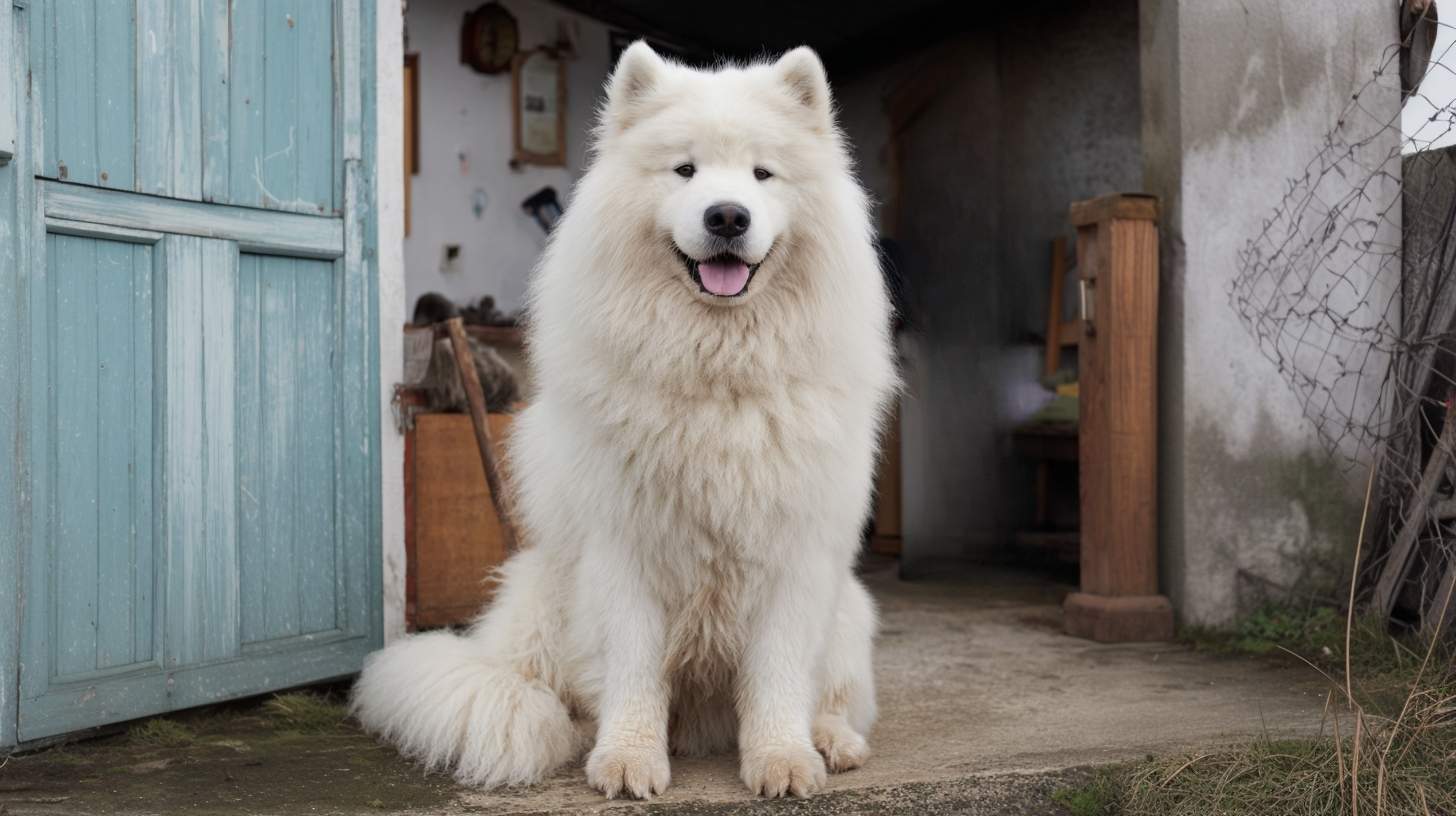
The Samoyed’s most photographed characteristic – the permanent upward curve of the lips that gives the breed its perpetual smiling expression – is not merely decorative. Indeed, it is a functional adaptation that natural selection developed in Arctic conditions.
In extreme cold, saliva freezes rapidly. A dog with lips that hang loosely or sag would accumulate ice crystals around the mouth, leading to frostbite of the lips and jowls. The Samoyed’s upturned lip corners prevent saliva from accumulating at the corners of the mouth, dramatically reducing the risk of lip freezing in temperatures where drool could become a survival hazard.
This functional explanation – beauty as a product of survival adaptation rather than selective aesthetics – is one of the most elegant examples in all of dog breed biology. Specifically, the smile that makes the Samoyed instantly recognizable globally is a 10,000-year-old solution to an Arctic engineering problem.
Samoyed Temperament: What to Expect
The Ancient People’s Companion
The Samoyed’s temperament reflects thousands of years of intimate living with humans in conditions where dog and human survival were interdependent. Unlike many working breeds that developed in a master-servant relationship with people, the Samoyed developed as a genuine partner – sharing shelter, warmth, and daily life with its people in a way that created mutual dependence rare in dog domestication history.
Consequently, this partnership history produces a dog with exceptional warmth toward people, broad social openness that extends readily to strangers as well as family, and a genuine sensitivity to human emotional states. Samoyeds are not guard dogs – their fundamental assumption about people is positive. A Samoyed that encounters a stranger typically greets them with the same warm enthusiasm as a familiar friend.
Energy and the Independent Spitz Mind
Samoyeds are moderately energetic dogs with the independence characteristic of spitz breeds that worked without constant handler direction. Like Alaskan Malamutes and Siberian Huskies, Samoyeds apply their intelligence to their own agenda as readily as to their owner’s instructions. They learn quickly but comply selectively – a characteristic that training must work with rather than against.
The Samoyed’s independence also produces a wandering tendency. Given an opportunity to explore beyond the boundary of a yard or home, most Samoyeds will take it. Furthermore, once they begin following a scent or interesting stimulus, recall becomes unreliable. Secure fencing is therefore essential.
Vocalization and Compatibility
Samoyeds are vocal dogs. They bark, howl, yodel, and produce the expressive vocalizations common to spitz breeds that communicated over long distances in open Arctic terrain. This vocalization requires management in suburban and apartment settings. However, a well-exercised, adequately stimulated Samoyed barks significantly less than an under-exercised or isolated one.
Notably, Samoyeds are among the most broadly compatible of the spitz breeds – generally good with children, other dogs, and often with cats when owners socialize them from puppyhood. Their gentle nature and patient temperament make them accessible family dogs for owners prepared for the grooming commitment.
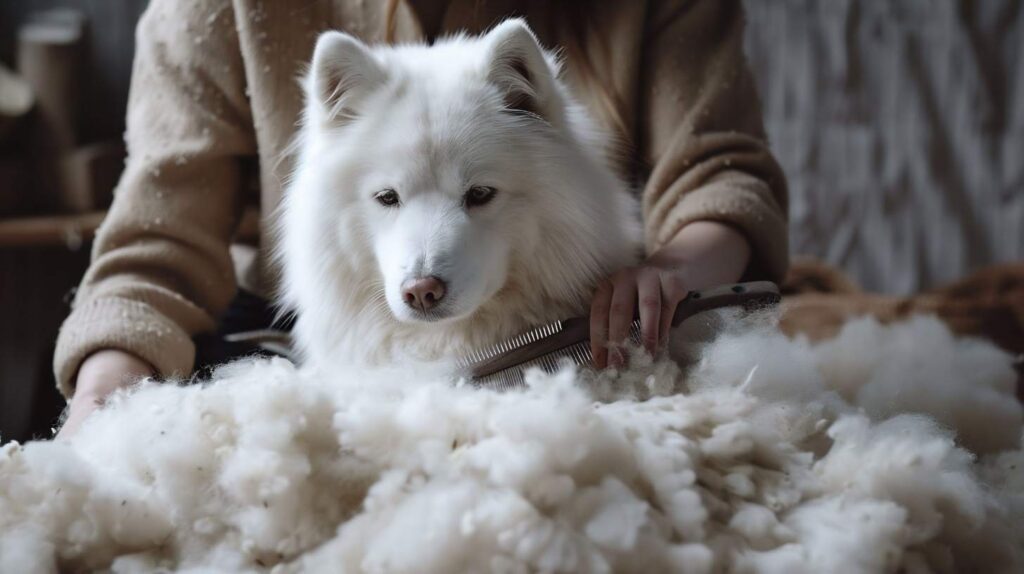
The Coat: One of the Most Demanding in the Dog World
Understanding the Double Coat
The Samoyed’s double coat consists of a dense, woolly undercoat that provides thermal insulation and a longer, harsh outer coat of pure white or biscuit-tipped guard hairs that shed water and reflect sunlight. This coat is functional in Arctic conditions and demanding to maintain in domestic settings. Specifically, the two annual blow periods create the most intensive grooming requirement of any common breed.
The Coat Blow Reality
Twice annually – in spring and autumn – the Samoyed releases its undercoat. During these 3-6 week blow periods, the volume of shed undercoat is staggering. Consequently, daily brushing for the entire blow period is not optional – neglected coat during a blow mats rapidly, creating tight tangles close to the skin that cause pain and require veterinary intervention to correct.
| Grooming Task | Regular Periods | Coat Blow Periods |
|---|---|---|
| Full brushing | 3-4 times per week | Daily without exception |
| Undercoat rake | Weekly | Daily |
| Bath with forced-air dry | Every 8-10 weeks | At start of blow – releases undercoat |
| Ear cleaning | Every 2 weeks | Every 2 weeks |
| Nail trimming | Every 3-4 weeks | Every 3-4 weeks |
| Teeth brushing | 3-5 times per week | 3-5 times per week |
| Professional grooming | Every 8-10 weeks | During blow for full deshedding treatment |
Never Shave a Samoyed
The double coat regulates temperature in both directions – the white outer coat reflects sunlight in summer to prevent overheating while the undercoat provides insulation in cold. Shaving removes both protections simultaneously and exposes the skin to direct UV radiation. Furthermore, post-clipping coat changes in Samoyeds can permanently alter coat texture and the characteristic pure white color. Instead, manage summer heat through exercise timing, shade, and air conditioning.
The Samoyed Fiber Community
Samoyed undercoat – called “Samoyed wool” or “pom” by enthusiasts – is a fine, warm fiber that enthusiasts can spin into yarn comparable in quality to cashmere or angora. Indeed, a dedicated community of fiber artists collects their dogs’ shed undercoat during blow periods and spins it into garments. This practice – called “chiengora” (from “chien,” the French word for dog) – turns the grooming challenge into a creative resource.
Health: Common Conditions in Samoyeds
Samoyed Hereditary Glomerulopathy (SHG)
SHG is a fatal kidney disease affecting male Samoyeds that destroys the glomerular filtration membrane in the kidneys, causing progressive kidney failure. Affected males typically develop symptoms between 3-15 months of age and die from kidney failure before age 2 without intervention.
The condition follows an X-linked recessive inheritance pattern. Carrier females – who may show mild or no symptoms – can pass the condition to male offspring. Fortunately, a DNA test is available. Responsible breeders test all breeding females and males and do not produce affected offspring. Therefore, every buyer of a male Samoyed must request SHG DNA test documentation for the breeding female.
Health Conditions Overview
| Health Condition | Prevalence | Signs to Watch For | Action |
|---|---|---|---|
| Samoyed Hereditary Glomerulopathy | Moderate – males | Increased thirst, poor growth, kidney failure | DNA test on dam (breeding female) – mandatory |
| Hip dysplasia | Moderate | Stiffness, abnormal gait | OFA evaluation on both parents |
| Progressive retinal atrophy (PRA) | Moderate | Night blindness progressing | DNA test + annual CAER eye exam |
| Subvalvular aortic stenosis (SAS) | Moderate – breed-specific | Heart murmur, exercise intolerance | OFA cardiac evaluation on parents |
| Diabetes mellitus | Moderate – elevated vs average | Increased thirst and urination | Annual blood glucose monitoring |
| Hypothyroidism | Moderate | Weight gain, lethargy, coat changes | Annual thyroid panel |
| Sebaceous adenitis | Low-moderate | Scaling, hair loss, coat texture changes | Dermatology referral |
| Bloat (GDV) | Low-moderate | Distended abdomen, retching, collapse | Emergency vet – pre-plan |
Subvalvular Aortic Stenosis (SAS)
SAS is a cardiac condition where abnormal tissue below the aortic valve restricts blood flow from the heart. Notably, it is more common in Samoyeds than in most other breeds. OFA cardiac examination of breeding dogs is the standard screening approach. Any Samoyed that receives a heart murmur diagnosis should have a veterinary cardiologist evaluation promptly.
Exercise: Active but Manageable
Overall, Samoyeds need 60-90 minutes of daily exercise – more than many similarly-sized companion breeds but less than the high-drive working breeds. Their reindeer herding and sled dog heritage means they have genuine endurance. However, their moderate domestic energy level makes them more accessible than Siberian Huskies or Alaskan Malamutes.
| Exercise Type | Suitability | Notes |
|---|---|---|
| Hiking | Excellent | Mental and physical combined |
| Brisk walking | Excellent | Primary daily activity |
| Off-leash in fenced area | Good | Wandering tendency requires security |
| Sledding and carting | Excellent | Breed-appropriate working activity |
| Agility | Good | Intelligence and athleticism combined |
| Swimming | Variable | Some Samoyeds enjoy water |
| Running in heat | Avoid | White coat reflects sun but overheating remains possible |
Training: Working With the Ancient Spitz Mind
Samoyeds learn quickly and apply their learning selectively – a combination characteristic of primitive spitz breeds that never experienced the generations of biddability selection that herding and retrieving breeds did. Consequently, positive reinforcement, high-value food rewards, short engaging sessions, and realistic expectations produce the most reliable outcomes.
| Training Priority | Why It Matters |
|---|---|
| Recall (ongoing priority) | Never fully reliable – wandering drive requires management |
| Leash manners | Pulling is a spitz default |
| Quiet command | Vocal breed – suburban management essential |
| Socialization from puppyhood | Reduces stranger wariness and dog reactivity |
| Alone-time tolerance | Separation anxiety prevention from day one |
Is a Samoyed Right for You?
Owners Who Succeed With Samoyeds
Samoyeds thrive with active families who exercise daily and owners who genuinely enjoy grooming interaction with their dog rather than treating it as a chore. They also suit cold-climate residents whose environment suits the breed’s coat, and homes with securely fenced yards. Above all, anyone drawn to the breed’s combination of ancient heritage, extraordinary appearance, and warm gentle temperament – and who approaches the coat blow with a plan rather than surprise – will find the Samoyed deeply rewarding.
Households That Struggle With Samoyeds
In contrast, Samoyeds are consistently challenging for owners who underestimate the grooming commitment – the most common reason for surrender. They also struggle in very hot climates without air conditioning, for apartment residents without immediate outdoor access, and for owners who want a quieter or more independent companion.
New puppy? Find a name that fits their personality.
Browse 600+ dog names by gender and personality type — playful, calm, bold, elegant, funny or mysterious.
Try Pet Name FinderFrequently Asked Questions
Samoyed History and Identity
Why do Samoyeds always look like they’re smiling? The permanent upward curve of the Samoyed’s lips is a functional adaptation to Arctic survival rather than selective breeding for appearance. In extreme cold, saliva freezes rapidly and accumulated ice at the corners of loose lips causes frostbite. Consequently, the upturned lip corners prevent saliva accumulation, making what appears to be a decorative smile actually a 10,000-year-old cold-weather survival feature.
Why were Samoyeds used on polar expeditions? Arctic explorers in the late 19th and early 20th centuries selected Samoyeds specifically because of their physical hardiness in extreme cold, their proven sled-hauling capability, and their compatibility with human team members in confined expedition conditions. Robert Scott, Fridtjof Nansen, and Ernest Shackleton all used Samoyeds successfully. Their experience in polar conditions surpassed other available sled dog breeds of the era.
Can Samoyed wool really be spun into yarn? Yes – Samoyed undercoat is a fine, warm fiber that enthusiasts collect during seasonal blow periods and spin into garments. The fiber is comparable in warmth to cashmere and the Samoyede people historically wove their dogs’ fur into clothing. Today, a global community of Samoyed owners practices this craft – called chiengora.
Samoyed Health and Care
What is Samoyed Hereditary Glomerulopathy? SHG is a fatal kidney disease specific to Samoyeds that primarily affects males. It destroys the kidneys’ filtration membrane, causing progressive kidney failure and typically death before age 2 in severely affected dogs. Carrier females pass it to affected males through X-linked inheritance. A DNA test is available. Requesting SHG DNA test documentation for the breeding female is therefore mandatory when purchasing any male Samoyed.
How do I manage the Samoyed coat blow? Daily brushing with a wide-tooth steel comb and undercoat rake for the entire blow period (3-6 weeks) is the foundation. A forced-air bath at the start of the blow releases significant undercoat immediately. Furthermore, many owners book a professional grooming deshedding treatment during the blow. Collecting the shed undercoat for spinning is an option that converts the grooming challenge into something productive.
Are Samoyeds good apartment dogs? Challenging but possible with significant management. Their size, moderate-high energy, vocal tendencies, and heavy coat all make apartment living difficult. However, adequate daily exercise, consistent quiet command training, and regular professional grooming can make it work. Cold-climate apartments with regular outdoor access to parks work considerably better than warm urban settings.
Do Samoyeds overheat easily? More than their white coat suggests but less than heavy-coated breeds. The white outer coat reflects sunlight, providing some protection against radiant heat. However, the dense undercoat limits air circulation and the breed’s Arctic origins provide no adaptation to sustained heat. Exercise must occur in early morning or evening in warm weather, water must be available constantly, and air conditioning is important above 75°F.
Key Takeaways
- The Samoyed smile is a functional Arctic survival adaptation, not selective breeding for appearance
- SHG DNA testing documentation for the breeding female is mandatory before purchasing any male Samoyed
- Coat blow management requires daily brushing for 3-6 weeks twice annually – this is the primary grooming commitment
- Never shave the coat – it regulates temperature in both directions and shaving causes permanent damage
- Recall is never fully reliable – secure fencing is essential for all outdoor exercise
- The Samoyede people and their dogs developed in genuine partnership over thousands of years – this history is visible in the breed’s people-orientation
- Polar exploration heritage includes Robert Scott, Fridtjof Nansen, and Ernest Shackleton – the breed’s Arctic capability is historically proven
- Samoyed fiber (chiengora) can spin into warm garments – the breed’s shed undercoat has genuine practical value
This article is for informational purposes only. Breed characteristics represent general tendencies and do not predict the behavior or health of any individual dog. Always consult a veterinarian for health advice.