Shih Tzu: Complete Breed Guide – Temperament, Care, Health & More (2026)
- 🐕 QUICK ANSWER: SHIH TZU BREED GUIDE
- ✅ Shih Tzus are affectionate, outgoing, and adaptable – bred exclusively as companion dogs for over 1,000 years
- ✅ Excellent for apartment living – low exercise needs and quiet, calm indoor temperament
- ✅ Weight: 9-16 lbs – small, sturdy, and less fragile than many toy breeds
- ✅ Friendly with everyone – children, strangers, other dogs, and cats
- ✅ One of the best breeds for owners seeking a low-energy, deeply affectionate companion
- ⚠️ Shih Tzus are brachycephalic – flat-faced anatomy causes breathing limitations and heat sensitivity
- ⚠️ The luxurious coat requires daily brushing if kept long – grooming commitment ranks among the highest of any small breed
- ⚠️ Dental disease is very common – small mouths and crowded teeth require daily brushing and regular professional cleanings
- ⚠️ Intervertebral disc disease (IVDD) is a risk in this chondrodystrophic breed – weight management and preventing jumping are important
- ❌ Do NOT exercise a Shih Tzu in hot or humid weather – brachycephalic anatomy makes them highly susceptible to heatstroke
- ❌ Do NOT skip daily eye cleaning – the prominent eyes and facial folds accumulate discharge that causes infections and staining
- This article draws on breed standards from the American Shih Tzu Club (ASTC) and The Kennel Club, health research from the ASTC Health Committee, and clinical guidance from veterinary dentists and ophthalmologists who specialize in brachycephalic toy breed health.
- Last Updated: May 2026
What Kind of Dog Is a Shih Tzu?
The Shih Tzu stands as one of the oldest dog breeds in existence and one of the few breeds that breeders developed entirely for companionship rather than working function. Its origins reach back to ancient China and Tibet, where Chinese emperors kept it as a sacred palace dog. The name Shih Tzu translates from Mandarin as “lion dog” – a reference to the breed’s resemblance to the lion in traditional Chinese Buddhist art.
For over a thousand years, the imperial Chinese court kept Shih Tzus exclusively for royalty. Court attendants gifted these dogs only to visiting dignitaries of the highest rank and never sold them to the general public. When the imperial Chinese court dissolved in the early 20th century, Westerners received some of these dogs, and the breed reached Europe in the 1930s. American military personnel stationed in Europe then brought the first Shih Tzus to the United States after World War II.
Today’s Shih Tzu remains essentially unchanged in its core purpose from the palace dog of ancient China. It serves as a companion dog bred to provide warmth, affection, and simple pleasure to the people it lives with. It has no herding instinct, no guarding drive, no retrieving compulsion, and no prey-chase impulse. Instead, it possesses an extraordinary desire to be with its people, receive and return affection, and make itself at home in whatever situation it encounters.
At a Glance: Shih Tzu Quick Reference
| Category | Details |
|---|---|
| AKC group | Toy Group |
| Origin | China / Tibet |
| Height | 9-10.5 inches |
| Weight | 9-16 lbs |
| Lifespan | 10-16 years |
| Energy level | Low to moderate |
| Exercise needed | 20-30 minutes per day |
| Grooming | High – daily brushing if coat kept long |
| Shedding | Very low – hair rather than fur |
| Trainability | Moderate – intelligent but independent |
| Good with children | Yes – better with older children |
| Good with other dogs | Excellent |
| Good with cats | Generally yes with socialization |
| Good with strangers | Friendly – no guarding instinct |
| Brachycephalic | Yes – heat and exercise limitations apply |
| IVDD risk | Moderate – chondrodystrophic breed |
| Dental disease risk | Very high – daily brushing essential |
| Apartment suitable | Excellent |
| First-time owner suitable | Yes |
Shih Tzu Temperament: What to Expect Living With One
The Pure Companion
The Shih Tzu’s entire behavioral profile centers on companionship. Unlike breeds with working heritage that maintain instincts for tasks beyond human company, the Shih Tzu developed through more than a thousand years of selection for traits that make it pleasant, attentive, and affectionate. This single-purpose breeding produces a dog that is remarkably consistent in its desire to please, its friendliness, and its emotional attachment to its people.
A Shih Tzu does not herd, guard, retrieve, or hunt. It sits with its owner, follows them from room to room, and expresses contentment through proximity and physical contact. Shih Tzu owners frequently describe their dogs as reading moods from across the room with uncanny accuracy. This sensitivity makes the breed an unusually attentive companion.
Friendliness Without Reservation
Shih Tzus extend genuine friendliness to everyone they meet – strangers, children, other dogs, and even cats. This openness represents a consistent breed characteristic that makes them poor guard dogs but excellent social companions. Furthermore, at a dog park, the Shih Tzu typically attempts to befriend every animal present, regardless of how those animals respond.
This friendliness extends to children, though practical considerations about size apply. Shih Tzus are sturdier than many toy breeds, but rough handling and accidental falls can still injure them. Older children who understand how to interact with a small dog make ideal companions. Households with toddlers should always supervise interactions carefully.
Independence and the Training Challenge
Despite their people-oriented nature, Shih Tzus retain a degree of independent thinking that their ancient palace heritage likely encouraged. A dog that palace inhabitants treated as a sacred treasure presumably never faced rigorous obedience demands. Consequently, Shih Tzus are intelligent dogs that understand what you ask of them and then apply their own assessment of whether compliance suits their current interest.
Training works well with consistent positive reinforcement and high-value food rewards in short, engaging sessions. Harsh corrections produce anxiety and resistance. Patience and consistency, however, produce a well-mannered and responsive companion.
Housetraining Considerations
Shih Tzus rank among the small breeds that owners most frequently find more challenging to housetrain than expected. The same independence that makes them selective about training compliance applies to housetraining. Nevertheless, a rigorous schedule, consistent outdoor trips, and high-value rewards for outdoor elimination produce reliable results. Keep in mind, though, that “over time” for a Shih Tzu often means 4-6 months rather than 4-6 weeks.
Brachycephalic Health: What Owners Must Manage
The Flat Face Reality
The Shih Tzu’s characteristic flat face – a shorter nasal passage, wider skull, and prominent eyes – represents the most important aspect of its physical management. Brachycephalic anatomy creates several ongoing health considerations that differ significantly from non-brachycephalic breeds.
| Anatomical Feature | Health Consequence | Management |
|---|---|---|
| Shortened nasal passages | Reduced airflow – increased breathing effort | Avoid overheating, limit strenuous exercise |
| Prominent eyes | Corneal ulcer and injury risk | Daily eye cleaning, avoid brambles and low branches |
| Facial skin folds | Moisture accumulation – skin fold dermatitis | Clean folds daily, ensure fully dry |
| Elongated soft palate | Partial airway obstruction – snoring | Surgical correction if breathing is significantly compromised |
| Stenotic nares (narrow nostrils) | Further airflow restriction | Surgical widening available for severe cases |
Heat Management
Shih Tzus cannot dissipate heat efficiently due to their compressed airway. Therefore, exercise during hot weather carries genuine heatstroke risk for this breed.
| Temperature | Exercise Guidance |
|---|---|
| Under 65°F (18°C) | Normal walks appropriate |
| 65-75°F (18-24°C) | Short gentle walks – monitor breathing closely |
| Above 75°F (24°C) | Indoor activity only – no outdoor exercise |
| High humidity at any temperature | Apply same caution as higher temperature |
Walk Shih Tzus in early morning or after sunset during warm months. Always carry water and stop immediately if the dog shows rapid or noisy breathing.
Grooming: The Highest Commitment of Shih Tzu Ownership
Two Coat Choices – One Decision That Shapes the Ownership Experience
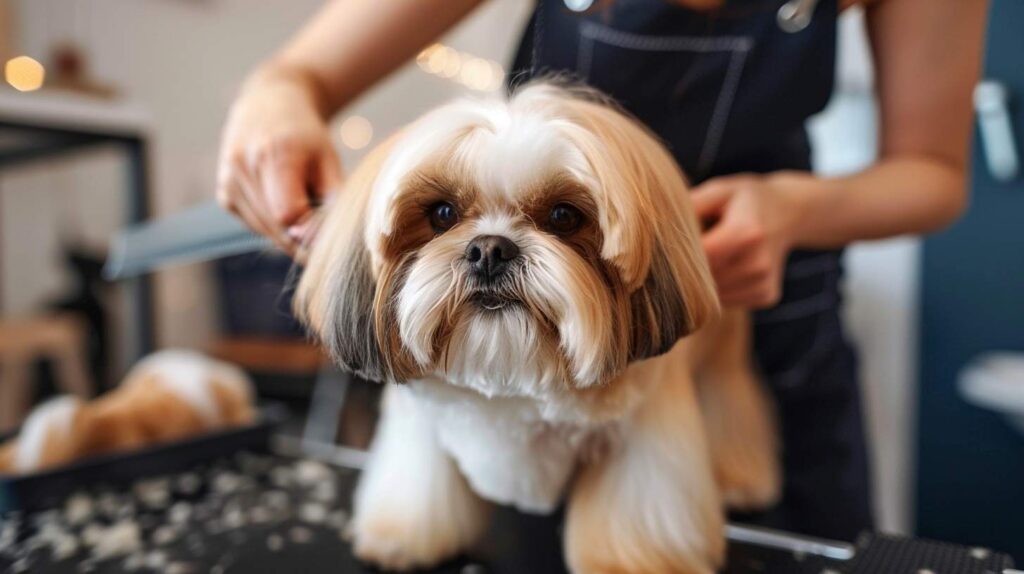
The most fundamental grooming decision for a Shih Tzu owner is whether to maintain a long show-style coat or a practical short puppy cut. This single decision determines the time, cost, and frequency of grooming throughout the dog’s entire life.
| Coat Style | Maintenance | Professional Grooming | Daily Brushing |
|---|---|---|---|
| Full floor-length show coat | Very high | Every 4-6 weeks | Required – daily |
| Puppy cut (2-3 inches all over) | Low-moderate | Every 6-8 weeks | 2-3 times per week |
| Teddy bear cut | Moderate | Every 6-8 weeks | 3-4 times per week |
The vast majority of pet Shih Tzu owners choose a puppy cut. Full show coats require not only daily brushing but also oil treatments, wrapping to prevent breakage, and a level of commitment that is genuinely impractical for most households.
Grooming Schedule
| Task | Frequency | Notes |
|---|---|---|
| Brushing (long coat) | Daily | Tangles form quickly – particularly behind ears and in armpits |
| Brushing (short coat) | 2-3 times per week | Less prone to matting but still requires regularity |
| Professional grooming | Every 6-8 weeks | Trim, bath, ear cleaning, nail grind |
| Teeth brushing | Daily – minimum 5 times per week | Non-negotiable – dental disease is the most common health problem |
| Eye area cleaning | Daily | Discharge and tear staining accumulate quickly |
| Facial fold cleaning | Daily | Moisture in folds causes skin fold dermatitis |
| Ear cleaning | Every 2 weeks | Hair grows in ear canal – may require plucking |
| Nail trimming | Every 3-4 weeks | Small nails grow quickly |
Tear Staining
The reddish-brown staining below the eyes of many Shih Tzus comes from porphyrin – a compound in tears that oxidizes on exposure to air. It appears more visibly on white and light-colored dogs. Daily cleaning of the eye area with a damp cloth reduces staining significantly. Specialized tear stain removers are available. However, addressing the underlying cause – blocked tear ducts, diet, or water mineral content – produces more effective results than topical treatment alone.

Health: Common Conditions in Shih Tzus
| Health Condition | Prevalence | Signs to Watch For | Action |
|---|---|---|---|
| Dental disease | Very high | Bad breath, reluctance to eat, tooth loss | Daily brushing + annual professional cleanings |
| Brachycephalic obstructive airway syndrome (BOAS) | High | Noisy breathing, exercise intolerance, blue gums | Surgical evaluation if breathing is compromised |
| Corneal ulcers and eye injuries | High | Eye squinting, discharge, cloudiness | Immediate vet attention – can cause blindness |
| Skin fold dermatitis | High | Redness, odor in facial folds | Daily fold cleaning, vet treatment if infected |
| IVDD | Moderate | Back pain, weakness, coordination loss | Ramps for furniture, weight management, vet if signs appear |
| Patellar luxation | Moderate | Skipping, holding leg up | Orthopaedic evaluation – surgical correction if severe |
| Hip dysplasia | Low-moderate | Stiffness, abnormal gait | OFA evaluation on both parents |
| Hypothyroidism | Moderate | Weight gain, lethargy, coat changes | Annual thyroid panel |
| Progressive retinal atrophy (PRA) | Moderate | Night blindness progressing | Annual eye exam, DNA testing |
| Renal dysplasia | Low-moderate | Increased thirst/urination, poor growth in young dogs | Veterinary evaluation |
Eye Emergencies
The Shih Tzu’s prominent eyes are vulnerable to injury in ways that owners must fully appreciate. Corneal abrasions from walking through low vegetation, eye proptosis from excessive pressure on the neck, and corneal ulcers from inadequate eye cleaning all occur more frequently in brachycephalic breeds than in other dogs.
Treat any eye squinting, excessive discharge, cloudiness, or visible injury as a same-day veterinary appointment. Eye conditions worsen rapidly, and delays can cause permanent vision loss.

Exercise: Gentle Needs With Breathing Awareness
Daily Requirements
Shih Tzus need 20-30 minutes of gentle exercise daily. This modest requirement suits apartment living, urban lifestyles, and owners with limited mobility very well. Two short walks of 10-15 minutes, combined with brief indoor play sessions, fully satisfies most Shih Tzus.
Their spaniel ancestry means they enjoy sniffing and exploring. Consequently, mentally engaging walks in varied environments satisfy them more than repetitive routes along the same path. Interactive indoor play – chasing a toy, learning a trick, or puzzle feeding – provides additional stimulation without the heat and exertion risks of outdoor activity.
| Exercise Type | Suitability | Temperature Restriction |
|---|---|---|
| Short leash walks (harness) | Excellent | Avoid above 72°F |
| Indoor fetch and play | Excellent | No restriction |
| Sniff walks | Excellent | Temperature managed |
| Dog parks | Caution – size difference | Supervise – larger dogs pose injury risk |
| Running or sustained exercise | Avoid | Breathing limitations |
A harness rather than a collar is essential for all leash activities. Neck pressure worsens breathing in brachycephalic breeds and risks tracheal injury in this breed specifically.
Training: Working With the Palace Dog
Shih Tzus respond best to short, positive, food-rewarded training sessions that owners conduct with patience and consistency. Their independent nature means they need to perceive training as enjoyable rather than compulsory. Fortunately, their food motivation and desire for their owner’s approval combine effectively to make patient positive training quite successful.
| Training Priority | Why It Matters |
|---|---|
| Housetraining (extended patience required) | Primary challenge for most owners |
| Quiet command | Alert barking is moderate in the breed – manageable with training |
| Recall | Never trust off-leash without reliable recall |
| Polite greetings | Jumping is minor at this size but worth addressing |
| Crate training | Helps with housetraining and provides safe space when alone |
For detailed positive reinforcement techniques, read our guide on dog separation anxiety.
Is a Shih Tzu Right for You?
Owners Who Succeed With Shih Tzus
Shih Tzus thrive with owners who seek a calm, affectionate, low-exercise companion dog. They suit apartment dwellers and urban residents particularly well. Additionally, elderly owners and those with limited mobility find the breed an ideal match. The Shih Tzu also suits households that commit to daily grooming and dental care, and anyone who wants a dog that is unambiguously oriented toward human companionship.
Households That Struggle With Shih Tzus
Shih Tzus consistently challenge owners who want a low-maintenance dog in terms of grooming. They also struggle in households in hot climates without reliable air conditioning. Families with toddlers who cannot yet handle a small dog safely, and owners who want a highly active outdoor companion, will find a different breed suits them better.
New puppy? Find a name that fits their personality.
Browse 600+ dog names by gender and personality type — playful, calm, bold, elegant, funny or mysterious.
Try Pet Name FinderFrequently Asked Questions
Shih Tzu Temperament and Daily Life
Are Shih Tzus hypoallergenic? No dog is truly hypoallergenic. However, Shih Tzus shed very little – their coat grows continuously like human hair rather than shedding seasonally. This significantly reduces airborne dander in the home, making them among the better choices for owners with mild dog allergies. The only reliable way to assess individual tolerance is direct exposure to the specific dog before purchase.
How often do Shih Tzus need professional grooming? Every 6-8 weeks is standard for dogs in a puppy cut. Dogs in a longer coat need professional grooming every 4-6 weeks. Additionally, at-home maintenance between appointments – daily or near-daily brushing and daily teeth cleaning – is equally important.
Are Shih Tzus smart? Yes, though their intelligence expresses itself selectively. They understand commands quickly and can learn a wide range of behaviors. Their independent nature, however, means compliance varies more than in highly biddable breeds. Training that uses high-value food rewards and short, engaging sessions produces consistently better results than repetitive drills.
Can Shih Tzus be left alone? For moderate periods – 4-6 hours – with appropriate preparation. Shih Tzus are social dogs that prefer company, but they are generally less prone to severe separation anxiety than some more intensely bonded breeds. Providing mental enrichment, a comfortable resting space, and a gradual alone-time training program reduces distress effectively.
Why do Shih Tzus have so many eye problems? The Shih Tzu’s prominent eyes are a direct consequence of brachycephalic skull structure. Eyes that protrude beyond the orbit of the skull are more exposed to environmental debris, drying, injury, and pressure. This anatomical reality requires daily eye cleaning, careful management of the facial coat around the eyes, and prompt veterinary attention for any eye discomfort.
Shih Tzu Health and Longevity
Are male or female Shih Tzus better? Both sexes make excellent companions. Males are often slightly more affectionate and consistent in their attention-seeking. Females may be marginally more independent. Individual personality, breeding, and upbringing influence temperament far more than sex, however. Spay or neuter both sexes unless you specifically intend responsible breeding.
How long do Shih Tzus live? Typically 10-16 years – one of the longer-lived small breeds. Dogs that receive daily dental care, appropriate weight management, regular veterinary attention, and protection from heat and overexertion consistently live toward the higher end of this range. Dental disease, BOAS, and IVDD are the conditions most directly under the owner’s control.
Key Takeaways
- Daily teeth brushing is non-negotiable – dental disease is the most common and most preventable health problem in the breed
- Daily eye area and facial fold cleaning prevents the most common Shih Tzu infections – both take under 2 minutes per day
- A harness rather than a collar is essential – neck pressure worsens brachycephalic breathing and risks tracheal injury
- Exercise in hot weather is dangerous – walk in early morning or after sunset during warm months
- The coat style choice determines the daily grooming commitment for the dog’s entire life – decide before acquisition
- Housetraining takes longer than most owners expect – 4-6 months of rigorous consistent effort is typical
- Shih Tzus rank among the best breeds for apartment and urban living – their low exercise needs and quiet temperament suit smaller spaces extremely well
- The breed’s 1,000-year history as a pure companion dog makes it extraordinarily compatible with human household life
This article is for informational purposes only. Breed characteristics represent general tendencies and do not predict the behavior or health of any individual dog. Always consult a veterinarian for health advice. Treat any eye squinting or injury as a same-day veterinary appointment.