How to Teach a Dog to Sit, Stay and Come: Basic Commands Guide
- Quick Answer: Sit, Stay, and Come are the three most important commands every dog should learn – and in that order. Sit is taught first because it forms the foundation for everything else. Stay builds on Sit by adding duration and distance. Come (recall) is arguably the most critical safety command a dog can know. All three are taught using positive reinforcement – treats, praise, and consistency. Sessions should be 5-10 minutes, several times a day, always ending on a success.
- Expert Source: Training methods in this article are drawn from the American Kennel Club (AKC) training programme, the AKC S.T.A.R. Puppy certification guidelines, and guidance from certified professional dog trainers.
Last Updated: April 2026
Basic obedience training is one of the most important things you will ever do for your dog. A dog that responds reliably to Sit, Stay, and Come is safer, calmer, easier to manage in public, and far less likely to end up in a dangerous situation. More than that, training builds the kind of trust and communication that makes the relationship between a dog and its owner genuinely enjoyable.
These three commands are not tricks. They are tools – and they work in real life, every day.
Before You Start: The Foundations of Effective Training
Every successful training session rests on the same principles. Get these right and everything else follows.
Positive Reinforcement Only
Dogs learn by association. When a behaviour produces a good outcome, they repeat it. When it produces nothing, they stop. Punishment – shouting, pushing the dog into position, correcting with the leash – does not teach a dog what to do. It teaches them to be uncertain and anxious around training. Positive reinforcement, using treats, praise, and toys as rewards, is both the most effective and the most humane approach.
Short Sessions, High Frequency
Dogs have limited attention spans, especially young ones. Sessions of 5-10 minutes, two to three times daily, produce far better results than a single 45-minute training block. End every session on a success – even if that means asking for something easy the dog already knows. A dog that ends a session feeling successful comes to the next one eager and ready.
One Command at a Time
Say the command word once, clearly and calmly. Repeating it – “Sit… sit… sit, I said SIT” – teaches the dog that the first repetition does not require a response. One word, one time. Then wait.
Timing of the Reward
The reward must come within 1-2 seconds of the desired behaviour. Any longer and the dog cannot make the association. This is why many trainers use a marker – either a clicker or a short word like “yes” – to mark the exact moment the correct behaviour happens, before the treat is delivered.
Choose High-Value Treats
For new commands, use treats your dog genuinely finds exciting. Small, soft, smelly treats work best – tiny pieces of chicken, cheese, or commercial training treats. Keep them tiny (the size of a fingernail) so you can reward frequently without filling the dog up.
Command 1: SIT
Sit is almost always the first command taught because it is naturally easy for dogs to perform and creates the foundation for Stay, Down, and many other behaviours.
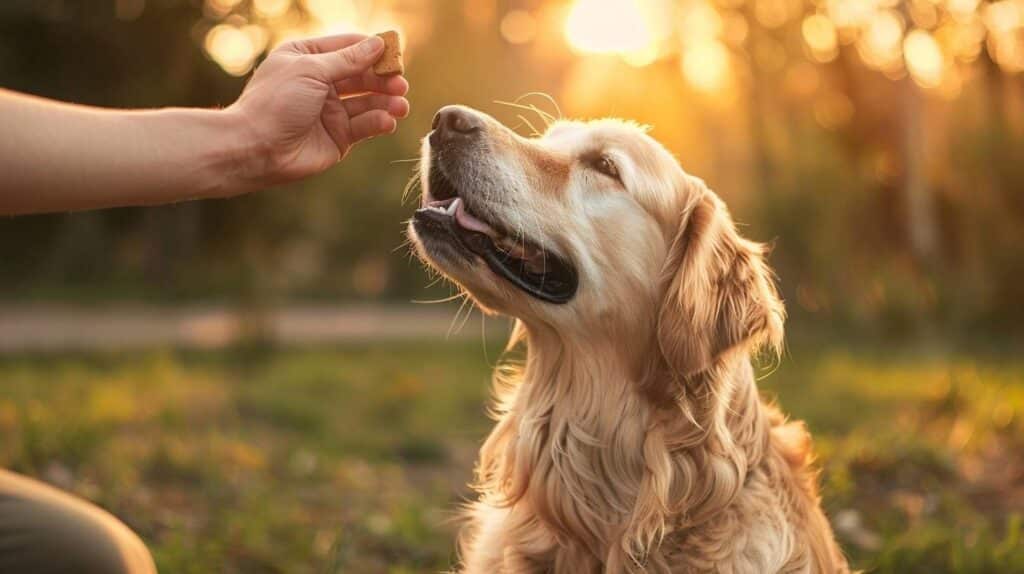
Step-by-Step: Teaching Sit
Step 1 – Lure into position Hold a treat close to your dog’s nose so they can smell it. Slowly move the treat up and back over their head, above eye level. As their nose follows the treat upward, their bottom will naturally lower toward the ground. Do not hold the treat so high they jump – keep it reachable but closed in your fist.
Step 2 – Mark and reward The moment their bottom touches the ground, say “Yes!” (or click your clicker) and give the treat. At this stage, do not say “Sit” yet – you are first teaching the physical movement.
Step 3 – Add the word Once your dog is reliably lowering into position when they see the treat move, begin saying “Sit” calmly just as their bottom starts to go down. Soon they will associate the word with the action.
Step 4 – Fade the lure Gradually reduce the visible treat. Move your hand in the same arc but with an empty fist. Reward from your other hand or pocket after they sit. Eventually the hand motion becomes a hand signal, and the verbal cue alone will work.
Common Mistakes: Sit
| Mistake | Why It Causes Problems |
|---|---|
| Saying “Sit” before the dog is in position | Dog associates the word with the process, not the end position |
| Pushing the dog’s hindquarters down | Creates confusion and discomfort – never force |
| Repeating the command multiple times | Teaches the dog to wait for the 3rd or 4th repetition |
| Rewarding too late | The dog cannot connect the treat to the action |
| Sessions that are too long | Dog becomes bored and unresponsive |
Practice Schedule: Sit
| Week | Goal |
|---|---|
| Week 1 | Sits reliably with lure in quiet room |
| Week 2 | Sits on verbal cue with minimal lure, multiple locations |
| Week 3 | Sits on first cue with distractions present |
| Week 4+ | Sits in all environments, with strangers, outdoors |
Command 2: STAY
Stay builds directly on Sit. Your dog must have a reliable Sit before you introduce Stay. The goal is not just to stay in position but to stay until you release them – which requires teaching a release word first.

The Release Word
Choose a release word – “OK,” “Free,” or “Release” – and teach it before working on Stay duration. Without a release word, your dog does not know when they are allowed to move, and will either break the Stay too early or remain frozen waiting for a signal that never comes.
To teach the release word: ask for a Sit, wait three seconds, say “OK” and toss a treat to the floor. The dog gets up to get the treat. Repeat until the dog reliably stands up and moves when they hear “OK.” Now they understand the release cue means “you may move.”
Step-by-Step: Teaching Stay
Step 1 – Start with a short stay Ask your dog to Sit. Hold your flat palm toward them like a stop sign and say “Stay” calmly once. Wait just two or three seconds. Return to them (do not call them to you at this stage), reward, then release with “OK.” Keep it very brief at the start.
Step 2 – Build duration before distance Increase the seconds your dog holds the Stay before you return and reward. Do not move away yet – just stand in front of them and gradually increase to 10, 20, 30 seconds before returning to reward. Duration comes before distance.
Step 3 – Add distance gradually Once your dog holds a Stay for 30 seconds with you standing close, take one step back. If they hold it, return to them and reward. Never call them to you during this phase – always return to reward, to avoid confusing Stay with Come.
Step 4 – Increase the 3 Ds: Duration, Distance, Distraction Build each element separately. More duration before more distance. More distance before distractions. Never increase two elements at the same time.
| Element | How to Build It |
|---|---|
| Duration | Add seconds gradually – 5, 10, 20, 30, 60 seconds |
| Distance | Add steps gradually – 1 step, 3 steps, across the room |
| Distraction | Add mild distractions only once duration and distance are solid |
Common Mistakes: Stay
| Mistake | Result |
|---|---|
| Adding distance before duration is solid | Dog breaks Stay immediately as soon as you move |
| Calling the dog to you during Stay practice | Dog learns Stay = I should start moving toward you |
| Increasing too many elements at once | Dog fails repeatedly and loses confidence |
| Not using a release word | Dog guesses when to move, becomes unreliable |
| Rewarding after the dog has already moved | Reinforces breaking the Stay |
Command 3: COME (Recall)
The recall – Come when called – is arguably the most important safety command a dog can know. A dog that reliably comes when called can be kept safe in an emergency. A dog that ignores the Come command cannot be off leash safely.
The recall must always be a positive experience. Never call your dog to you for something they dislike – baths, nail trimming, ending a play session, being put in the car when they do not want to go. If “Come” consistently precedes things the dog finds unpleasant, they will stop responding to it.

Step-by-Step: Teaching Come
Step 1 – Start close and make it exciting In a quiet room, crouch down to your dog’s level, say their name followed by “Come!” in a happy, enthusiastic voice. Open your arms. When they reach you, reward generously with treats and praise. Make arriving at you the best thing that ever happens to them.
Step 2 – Practice on a long line Move outdoors but attach a 5-7 metre training lead. This allows you to practise recall with freedom while maintaining safety. If the dog does not respond, gently guide them to you with the lead – never chase. Chasing teaches the dog that running away starts a fun game.
Step 3 – Increase distance gradually As the dog responds reliably to a short distance recall, gradually practise from further away. Keep the tone happy and celebratory every single time.
Step 4 – Add distractions slowly Begin practising in gradually more distracting environments – a quiet garden, a park with people at a distance, eventually near other dogs. Always reward heavily for coming to you from a distraction-filled environment.
Step 5 – Never punish a recall If your dog does not come immediately, do not scold them when they eventually arrive. Punishment on arrival teaches the dog that coming to you results in something bad. Even if you are frustrated, always reward the dog for arriving.
Recall Emergency Technique
For true emergencies – dog heading toward a road – use a completely different word from everyday Come. Train a “emergency recall” word (some trainers use “HERE” in a sharp, urgent tone) separately with your highest value treats. Reserve this word exclusively for emergencies and always reward extremely generously when used.
Training All Three Commands Together: A Weekly Plan
| Phase | Focus | Session Length | Frequency |
|---|---|---|---|
| Week 1 | Sit only – lure and mark | 5 minutes | 3x daily |
| Week 2 | Sit with verbal cue + Come in quiet area | 7 minutes | 2-3x daily |
| Week 3 | Sit + Stay (duration only, 2-5 steps) | 8 minutes | 2x daily |
| Week 4 | All three – short sequences | 10 minutes | 2x daily |
| Week 5+ | All three with mild distractions + new locations | 10 minutes | Daily |
Did your dog eat something dangerous? Find out right now.
Enter what they ate and their weight — get an instant toxicity assessment for 35+ substances.
Check Toxicity NowTraining Different Life Stages
Puppies (8-16 weeks)
Start training immediately. Puppies can begin learning commands as soon as they come home at 8 weeks. Their attention spans are very short – keep sessions to 3-5 minutes maximum. Use tiny high-value treats and very enthusiastic praise. At this age, the goal is to make training feel like the best game in the world.
Adult Dogs (1-7 years)
Adult dogs learn just as effectively as puppies – the idea that “you cannot teach an old dog new tricks” is a myth. Training may progress slightly faster because adult dogs have longer attention spans. Use the same positive reinforcement methods.
Senior Dogs (7+ years)
Senior dogs can learn new commands but may tire more quickly. Keep sessions shorter. If an older dog has previously learned commands through punishment-based methods, they may initially be hesitant – patience and consistency will rebuild confidence. Consider any physical limitations – a dog with arthritis should not be asked to sit on hard cold floors.
Frequently Asked Questions About Dog Basic Commands
Training Questions
At what age should I start teaching my dog these commands? Training can and should begin the moment your puppy comes home – typically around 8 weeks of age. Very young puppies have short sessions (3-5 minutes) but are enormously receptive to learning. The earlier commands are established, the more deeply embedded they become. Adult and senior dogs can also learn these commands at any age.
My dog knows Sit at home but ignores me in public. Why? This is called the “generalisation problem” – the dog has learned to Sit in a specific context (your living room) but has not yet learned that the command applies everywhere. The solution is gradual, systematic practice in new locations with increasing levels of distraction. Begin in your garden, then outside the front of your house, then a quiet park, then busier environments. Each new location essentially means starting again from a slightly easier version of the command.
How long does it take to teach these commands? Most dogs can learn a basic Sit within a single session. A reliable Sit that holds in all environments typically takes 2-4 weeks of consistent daily practice. Stay and Come take longer because they involve more complex criteria – expect 4-8 weeks for reliable performance. Duration, distance, and distraction are added gradually. Rushing the timeline produces unreliable commands.
Should I use a clicker or just say “Yes”? Both work equally well. A clicker produces a consistent, unique sound that marks the exact moment of correct behaviour. A verbal marker like “Yes!” or “Good!” serves the same purpose. Clickers are particularly useful for precise timing when teaching complex behaviours. Choose whichever you will use consistently.
Behaviour and Consistency Questions
My dog knows “Stay” but keeps breaking it when I walk away. What should I do? You have probably increased distance before duration was solid enough. Go back to basics – practice Stay with no movement from you for longer durations (30-60 seconds) before adding any distance. When you do add distance, add just one step. Build very gradually. Stay is a three-part skill – duration, distance, and distraction – and each must be built separately.
Can I teach these commands without treats? Yes, but treats make the process significantly faster and more reliable, particularly in the early stages. Dogs are highly food motivated. If treats are not working, it usually means either the treats are not high value enough (try chicken, cheese, or freeze-dried meat), the dog is not hungry enough during sessions, or sessions are too long and the dog has lost motivation. Praise and play can also function as rewards for dogs that are toy or affection motivated.
My dog comes when called at home but runs away from me outside. What should I do? Outside, the environment offers competing rewards – smells, other dogs, freedom. Your recall needs to be stronger than the environment. Practice recall on a long line outdoors where the dog cannot self-reward by running off. Always use extremely high-value treats outdoors – what works indoors often needs to be upgraded for outdoor use. Never allow off-leash access to an unfenced area until recall is genuinely reliable.
Key Takeaways
Sit, Stay, and Come are not just training exercises – they are the foundation of a safe, manageable, and enjoyable relationship with your dog. Teach them in order: Sit first, then Stay, then Come. Use positive reinforcement only – food rewards, praise, and play. Keep sessions short (5-10 minutes), frequent (2-3 times daily), and always end on success. Build each skill gradually by adding duration before distance, distance before distraction, and never two elements at once. The time invested in these three commands pays dividends every day for the rest of your dog’s life.
New puppy? Find a name that fits their personality.
Browse 600+ dog names by gender and personality type — playful, calm, bold, elegant, funny or mysterious.
Try Pet Name FinderThis article is for informational purposes only and does not replace guidance from a certified professional dog trainer. For dogs showing signs of fear, aggression, or significant behavioural problems, always consult a qualified behaviourist.