Maine Coon: Complete Breed Guide – Temperament, Care, Health & More (2026)
- Quick Answer: The Maine Coon is the largest domestic cat breed in the world and the most popular cat breed globally according to 2024 FIFe statistics. They are affectionate, intelligent, playful, and famously dog-like in their behaviour — following their people around, chirping and trilling, and even learning to fetch. They are hardy cats well-suited to active households and families. Their most important health concern is hypertrophic cardiomyopathy (HCM), a serious heart condition affecting 10–15% of the breed, which requires annual cardiac screening throughout the cat’s life.
- Expert Source: Health data in this article is drawn from Swedish pet insurance studies on Maine Coon lifespan, a study of HCM prevalence published through the Veterinary Cardiac Genetics Lab at Washington State University College of Veterinary Medicine, the Royal Veterinary College VetCompass Programme, and the Cat Fanciers’ Association breed standards.
- Last Updated: March 2026
If you have ever met a Maine Coon, you likely never forgot the encounter. At up to 11 kg and 100 cm in length, with a full ruff of fur around the neck, tufted ears, enormous paws, and a magnificent bushy tail, the Maine Coon is simply unlike any other domestic cat. Add to this a personality that routinely confounds cat stereotypes — enthusiastic, sociable, vocal in chirps and trills rather than meows, and genuinely interested in whatever you are doing — and it becomes clear why they have become the world’s most registered pedigree breed.
Maine Coon At a Glance
| Characteristic | Detail |
|---|---|
| Origin | Maine, USA — natural breed |
| Size | Very large — largest domestic cat breed |
| Height | 25–41 cm (10–16 inches) at the shoulder |
| Length | Up to 100 cm (40 inches) including tail |
| Weight | Male: 6–11 kg (13–25 lbs); Female: 4–6 kg (9–14 lbs) |
| Lifespan | 12–15 years |
| Coat | Semi-long, dense, water-resistant — 75+ colour variations |
| Shedding | Heavy — especially spring and autumn |
| Energy level | Moderate to high |
| Grooming needs | Moderate — 2–3 times per week |
| Trainability | High — one of the most trainable cat breeds |
| Good with children | Excellent |
| Good with other pets | Excellent |
| Good for first-time owners | Yes |
| Apartment living | Possible with sufficient enrichment |
| Vocalisation | Moderate — distinctive chirps and trills |
History and Origin
The Maine Coon is one of the oldest natural cat breeds in North America and the only long-haired breed native to the United States. Their exact origins are surrounded by colourful folklore — theories include descent from Marie Antoinette’s Turkish Angoras, Viking ship cats, or crossing with raccoons (biologically impossible, but a persistent myth that may explain the breed’s name and famously bushy, ringed tail).
The scientific consensus is more straightforward: Maine Coons most likely developed from long-haired cats brought to North America by early seafarers, which then crossbred with local short-haired cats in the harsh climate of New England. Generations of natural selection in the Maine winters produced a cat superbly adapted to cold — with a dense, water-resistant coat, tufted ears that trap warm air, heavily furred paws that function as natural snowshoes, and a thick tail that can wrap around the body for warmth.
The breed was popular at American cat shows in the late 19th century, then fell from fashion as Persian cats took over. By the mid-20th century, they were considered potentially extinct. A dedicated revival effort culminated in formal recognition by the Cat Fanciers’ Association (CFA) in 1976, and the Maine Coon has risen steadily in popularity ever since. In 2024, FIFe statistics recorded the Maine Coon as the world’s most popular pedigree cat breed — comprising 24.7% of all registered kittens globally.
In 1985, the US state of Maine officially designated the breed as the Maine state cat.
Temperament and Personality
The Maine Coon’s personality is one of the most distinctive of any cat breed — and the primary reason so many owners describe them as “dog-like.”

Key Personality Traits
Deeply sociable. Maine Coons are not aloof cats. They want to be present in every room, involved in every activity, and aware of every person who enters their territory. They follow their owners from room to room with a level of loyalty and interest that surprises people who expect cats to be independent.
Playful well into adulthood. Maine Coons are often described as the “clowns of the cat world.” They maintain a kitten-like playfulness for many years, and many individuals continue active play well into old age. They will retrieve toys, learn tricks, and engage in extended play sessions that exhaust their owners before the cat.
Communicative and vocal. Rather than the standard cat meow, Maine Coons communicate through an extensive repertoire of chirps, trills, chatters, and soft conversational sounds. They will “talk back” when spoken to and announce themselves as they move through the house.
Intelligent and trainable. Maine Coons are among the most trainable of all cat breeds. They learn their names quickly, respond to recall, can be leash-trained, learn tricks, and some have been trained to use modified cat doors and solve puzzle feeders at a level that surprises their owners.
Gentle with children and other animals. Their calm, patient temperament makes them exceptional family cats. They tolerate gentle handling, get along with well-behaved dogs, and generally do not react defensively to the level of noise and activity that a family household generates.
Water curious. Unlike most domestic cats, Maine Coons are often fascinated by water — dipping paws into water bowls, splashing in sinks, and occasionally attempting to join their owners in the shower. This is thought to be a remnant of their maritime ancestry and their semi-water-resistant coat.
Not typically lap cats. Despite their affectionate nature, Maine Coons often prefer to be near their people rather than on them. Given their size, this is often a comfort advantage for both parties — but they will choose proximity to their favourite person consistently.
Exercise and Enrichment
Maine Coons are active cats who need more stimulation than less energetic breeds. They are physically large and naturally athletic, and an under-enriched Maine Coon can become bored and destructive.
| Enrichment Type | Why It Matters |
|---|---|
| Tall cat trees and shelves | Maine Coons love height — vertical space is essential |
| Interactive wand toys | Daily play sessions; 15–20 minutes twice daily |
| Puzzle feeders | Mental stimulation — Maine Coons excel at these |
| Leash walking | Excellent outlet; many Maine Coons take to it readily |
| Fetch and retrieval games | Naturally inclined; great for indoor exercise |
| Window perches | Environmental enrichment — bird watching is a favourite |
Maine Coons are one of the few cat breeds that can be successfully leash-trained for outdoor adventures, which is an excellent compromise for indoor cats in households with access to safe outdoor areas.

Grooming
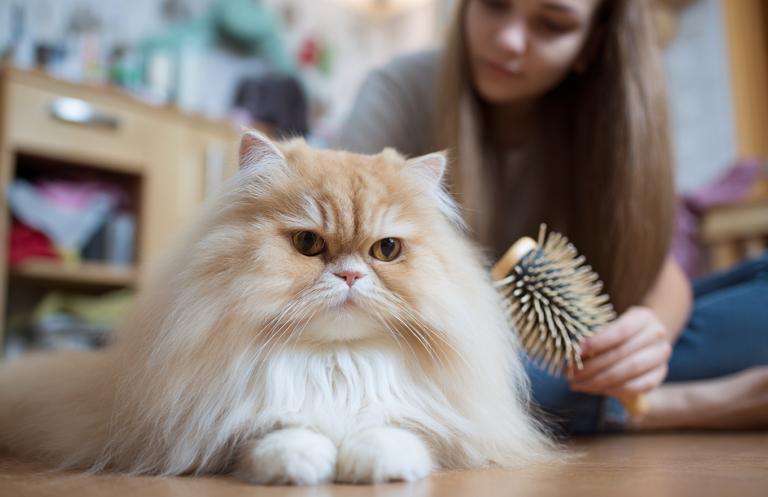
The Maine Coon’s coat is semi-long and dense, but significantly easier to maintain than a Persian’s. The coat has a silky texture that resists matting better than other long-haired breeds — though regular brushing is still necessary, particularly during the twice-yearly heavy shedding seasons.
| Task | Frequency |
|---|---|
| Brushing | 2–3 times per week; daily during shedding season |
| Bathing | Every 6–8 weeks — tolerated well by most Maine Coons |
| Ear cleaning | Weekly — prone to wax accumulation and debris in tufted ears |
| Nail trimming | Every 3–4 weeks — large paws with prominent claws |
| Teeth brushing | Daily if possible; minimum 3 times per week |
Maine Coons have the longest whiskers of any domestic cat breed, so extra-wide food and water bowls are recommended — whisker fatigue (discomfort from whiskers touching bowl sides during eating) is a genuine issue in this breed.
Health – What Maine Coon Owners Must Know
Maine Coons are generally considered a robust and healthy breed, but they carry two significant inherited health conditions that every owner should understand.

Hypertrophic Cardiomyopathy (HCM)
HCM is the most important health concern for Maine Coons and the most common cause of heart disease in cats generally. It involves abnormal thickening of the heart muscle walls, which reduces the volume of blood the heart can pump effectively. As the disease progresses, it can cause heart failure, blood clots, breathing difficulties, and sudden death.
HCM affects approximately 10–15% of Maine Coons. A mutation in the MYBPC3 gene has been identified in Maine Coons that is associated with HCM — approximately one-third of Maine Coons tested at Washington State University’s Veterinary Cardiac Genetics Lab tested positive for this mutation.
Critically, the DNA test only identifies one known mutation. A negative result does not mean a cat is HCM-free — it means the cat does not carry that one identified mutation. Some Maine Coons with clinical HCM test negative for the known mutation, strongly suggesting a second mutation exists in the breed. This is why annual echocardiograms are recommended throughout the cat’s life in addition to genetic testing.
Signs of HCM to monitor: laboured breathing, lethargy, open-mouth breathing, reduced appetite, sudden hind limb weakness or paralysis (caused by blood clots — a cardiac emergency requiring immediate veterinary attention).
Other Key Health Conditions
| Condition | Description | What to Watch For |
|---|---|---|
| Hypertrophic Cardiomyopathy (HCM) | Heart muscle thickening — 10–15% prevalence | Laboured breathing, lethargy, sudden hind limb weakness |
| Hip dysplasia | Abnormal hip joint development — ~20% prevalence | Reluctance to jump, bunny-hop gait, stiffness |
| Spinal Muscular Atrophy (SMA) | Genetic loss of spinal cord neurons — DNA test available | Wobbling gait, muscle weakness appearing at 3–4 months in kittens |
| Polycystic Kidney Disease (PKD) | Inherited kidney cysts — less common than in Persians | Increased thirst, weight loss, lethargy |
| Obesity | Large frame combined with indoor lifestyle — high risk | Loss of waist definition, inability to feel ribs |
The Slow Maturation Factor
Maine Coons are unusual among cats in that they take 3–5 years to reach full physical and social maturity — significantly longer than most breeds, which mature at around 12–18 months. This means a 2-year-old Maine Coon still behaves in many ways like a kitten. This extended development period should be accounted for in nutrition (kitten food until at least 15 months), veterinary assessments, and behavioural expectations.
Choosing a Responsible Breeder
Given the severity of HCM, choosing a breeder who takes cardiac health seriously is the single most important decision a prospective Maine Coon owner can make. Responsible breeders:
- DNA test all breeding cats for the known HCM mutation (MYBPC3)
- Have breeding cats echocardiographed regularly — not just tested by DNA
- Do not breed HCM-positive cats
- Are transparent about health history in their lines
- Can provide documentation of both parents’ test results
In the UK, from June 2024, Maine Coons must be negative for the PKDef (Pyruvate Kinase Deficiency) mutation before being added to the GCCF Active Breeding Register — a positive development for breed health.
Lifespan
Swedish pet insurance data found a median lifespan of more than 12.5 years for Maine Coons, with 74% living to 10 years or more and 54% reaching 12.5 years or beyond. A UK study found a life expectancy of 9.71 years, compared to 11.74 years overall for all cats — the gap partly explained by the breed’s HCM risk and large size.
Feeding a Maine Coon
Maine Coons require more food than average-sized cats due to their size, but this does not mean unlimited feeding. Obesity is a significant risk and worsens hip dysplasia and HCM. Feed according to the cat’s actual weight and body condition score — not their impressive size.
Use extra-wide, shallow bowls to accommodate their long whiskers. Wet food should form a significant part of the diet, supporting kidney health and hydration. Kitten food should be continued until the cat reaches physical maturity at approximately 15 months.
Did your cat eat something dangerous? Find out right now.
Enter what they ate and their weight — get an instant toxicity assessment for 35+ substances.
Check Toxicity NowIf your Maine Coon ever ingests something potentially harmful, use our Pet Toxicity Calculator immediately.
Is a Maine Coon Right for You?
Maine Coons Are Ideal For:
- Active families with children of any age
- Multi-pet households — Maine Coons typically befriend both cats and dogs
- Those who want a sociable, interactive cat rather than an independent one
- People who enjoy training and enrichment activities
- Households with space for vertical enrichment and tall cat trees
- Those who want a long-term, deeply bonded companion
Maine Coons May Not Suit:
- People with very limited time for play and interaction
- Those unable to commit to annual cardiac screening (echocardiograms)
- Very small apartments without enrichment options
- Those who prefer a quiet, undemanding cat
- Anyone unwilling to manage higher potential veterinary costs
Frequently Asked Questions About Maine Coon Cats
Breed and Temperament Questions
How big do Maine Coons get? Maine Coons are the largest domestic cat breed. Males typically weigh 6–11 kg (13–25 lbs) and can reach up to 100 cm in total length including their tail. Females are somewhat smaller at 4–6 kg (9–14 lbs). Full size is not reached until 3–5 years of age — significantly later than most breeds. Some exceptionally large individuals have been documented at over 14 kg.
Are Maine Coons good with children and dogs? Exceptionally well. Their gentle, patient, and sociable temperament makes them among the best cat breeds for family households. They tolerate the noise and activity of children, adapt readily to well-mannered dogs, and generally choose engagement over avoidance when introduced to new companions.
Why do Maine Coons chirp instead of meow? Maine Coons communicate through a distinctive repertoire of trills, chirps, and chattering sounds in addition to conventional meows. This is a breed characteristic rather than a sign of any problem. Many owners find it one of the most endearing and conversational traits of the breed — Maine Coons will frequently “respond” when spoken to and announce themselves as they enter rooms.
Are Maine Coons indoor or outdoor cats? Maine Coons are naturally active and curious, and many do well with safe outdoor access — they were originally outdoor working cats. However, indoor-only life is entirely appropriate with sufficient enrichment, and it significantly reduces risks from predators, disease, and accidents. Leash training is an excellent solution that provides outdoor stimulation with safety.
Do Maine Coons really like water? Many do, yes. Maine Coons frequently show unusual interest in water — pawing at water bowls, sitting near running taps, and occasionally joining owners in bathrooms. Their semi-water-resistant coat and maritime ancestry are thought to contribute to this trait. It is harmless and owners typically find it entertaining.
Health and Care Questions
What is HCM and how do I screen my Maine Coon for it? Hypertrophic cardiomyopathy is a heart muscle disease affecting approximately 10–15% of Maine Coons. The gold standard of preventive care is an annual echocardiogram (cardiac ultrasound) from age 2–3 onwards. DNA testing for the known MYBPC3 mutation is also available and useful, but a negative result does not guarantee the cat is free from HCM — annual echocardiograms remain essential. Ask your vet to refer you to a cardiologist or veterinary practice offering cardiac screening.
How often do Maine Coons need grooming? Two to three times per week for most of the year, increasing to daily during heavy shedding seasons in spring and autumn. Their semi-long coat is significantly easier to maintain than a Persian’s — it resists matting better — but still requires regular attention. Many Maine Coons enjoy brushing and actively seek it out as an interaction with their owner.
When do Maine Coons stop growing? Maine Coons reach full physical maturity at approximately 3–5 years of age — much later than most cat breeds, which mature at 12–18 months. A 2-year-old Maine Coon still has significant growth ahead of it. Kitten-appropriate food should be continued until at least 15 months, and some owners continue a growth formula until 2 years for this reason.
What size litter box does a Maine Coon need? Larger than standard. Maine Coons need jumbo-sized litter boxes — roughly 1.5 times larger than a standard box. Many owners use large storage containers or purpose-built oversized litter boxes. Providing adequate space prevents elimination issues caused by discomfort using a box that is too small.
Key Takeaways
The Maine Coon is one of the most rewarding cat breeds it is possible to own — sociable, intelligent, affectionate, and full of personality in a package that is genuinely impressive in scale. Their most significant health requirement is cardiac monitoring: annual echocardiograms throughout their life are the gold standard for managing their HCM risk. Choose a responsible breeder who takes cardiac health seriously, invest in comprehensive pet insurance, provide adequate vertical enrichment and daily interactive play, and a Maine Coon will repay the investment with years of engaged, loyal, and characterful companionship.
New cat? Find a name as unique as their character.
Browse 600+ cat names by gender and personality type — because every cat has a story.
Try Pet Name FinderThis article is for informational purposes only and does not replace advice from a qualified veterinarian. For health concerns about your Maine Coon, always consult your vet – ideally one with experience in cardiac conditions in cats.