Interactive Cat Toys: Best Types & How to Use Them for a Happier Cat
- Quick Answer: Interactive cat toys are one of the most effective tools for keeping indoor cats physically fit, mentally stimulated, and behaviourally balanced. The best types include wand/feather toys (for owner-led play), electronic automated toys (for solo play), and puzzle feeders (for mental enrichment). The key is matching the toy type to your cat’s personality, rotating toys regularly to prevent boredom, and always ending play sessions with a successful “catch” to satisfy the hunting instinct.
Last Updated: April 2026
Cats sleep between 12 and 16 hours a day. That is not laziness – it is how they are built. In the wild, a cat conserves energy between hunting sessions, bursting into intense activity to stalk, chase, and catch prey. The problem for indoor cats is that without adequate stimulation, those energy bursts have nowhere to go. Boredom, obesity, anxiety, destructive behaviour, and aggression are the predictable consequences.
Interactive cat toys solve this problem by giving indoor cats an outlet for the hunting behaviours that are hard-wired into them – stalking, chasing, pouncing, and catching. Used consistently, they are one of the most effective ways to improve your cat’s physical health, mental wellbeing, and overall quality of life.
This guide covers every type of interactive toy, how each one works, which cats benefit most, and how to get the most out of play sessions.
Why Interactive Play Matters for Indoor Cats
Cats are obligate carnivores who evolved as solitary hunters. Unlike dogs, which are pack animals adapted for social cooperation, cats hunt alone – relying entirely on their own intelligence, stealth, and reflexes. Play is how kittens learn to hunt, and it is how adult cats maintain those same neural pathways throughout their lives.
For indoor cats, this matters more than most owners realise. Studies in feline behaviour consistently show that insufficient mental and physical stimulation leads to predictable problems:
- Obesity – indoor cats that do not play regularly have significantly higher rates of weight problems, which contribute to diabetes, joint disease, and shortened lifespan
- Anxiety and stress – an under-stimulated cat has no outlet for nervous energy, which can manifest as hiding, over-grooming, or compulsive behaviours
- Destructive behaviour – scratching furniture, knocking objects off surfaces, or excessive vocalisation at night are often expressions of unmet activity needs
- Aggression – cats that do not get adequate play outlet may redirect predatory energy toward owners or other pets
Play is not optional enrichment for indoor cats – it is a fundamental health requirement.

The Hunt Sequence: What Your Cat Needs From Play
To understand what makes an interactive toy effective, it helps to understand the feline hunt sequence. A cat’s natural hunting behaviour follows a predictable pattern: stare → stalk → chase → pounce → catch → kill → eat.
The best interactive toys engage as many stages of this sequence as possible. This is why a feather wand that moves erratically and allows the cat to chase, leap, and finally pin it is far more satisfying than a static toy that does not move. Completing the sequence – particularly the catch – releases neurochemicals associated with satisfaction and reward.
An important implication: play sessions should always end with the cat successfully catching the toy. Cats that repeatedly chase without ever catching become frustrated, which can actually increase rather than reduce tension. End every play session with a few easy catches, then offer a small treat or meal to complete the sequence with the “eat” stage.
Types of Interactive Cat Toys
1. Wand and Feather Toys
Best for: Active play, bonding with owner, all life stages
Wand toys – a stick or rod with feathers, ribbons, or other lures attached – are the most versatile and effective category of interactive toy. They allow you to mimic the unpredictable movement of prey: fluttering, darting, pausing, hiding behind furniture, and zigzagging across the floor.
New cat? Find a name as unique as their character.
Browse 600+ cat names by gender and personality type — because every cat has a story.
Try Pet Name FinderThe key is the unpredictability of movement. A wand toy moved with realistic prey-like patterns – jerky, pausing, retreating – triggers a far more intense hunting response than smooth, predictable motion.
How to use them well:
- Move the toy away from the cat, not toward them – prey runs away, not toward a predator
- Use irregular movements: dart, pause, flick, hide the lure under a blanket
- Let the cat catch and “kill” the toy periodically – every 3-5 minutes of chase
- End the session with easy catches and reward with a treat or meal
Popular options: Da Bird Original Feather Toy, KONG Active Feather Teaser, Cat Dancer
Important safety note: Store wand toys with strings when not in use. Cats can become entangled in strings or swallow lures if left unsupervised with string-based toys.
2. Electronic and Automated Toys
Best for: Solo play, busy owners, cats who need stimulation during the day
Automated toys move, vibrate, spin, or flutter on their own – allowing cats to play without requiring owner participation. They are particularly valuable for cats left alone during working hours.
Sub-types include:
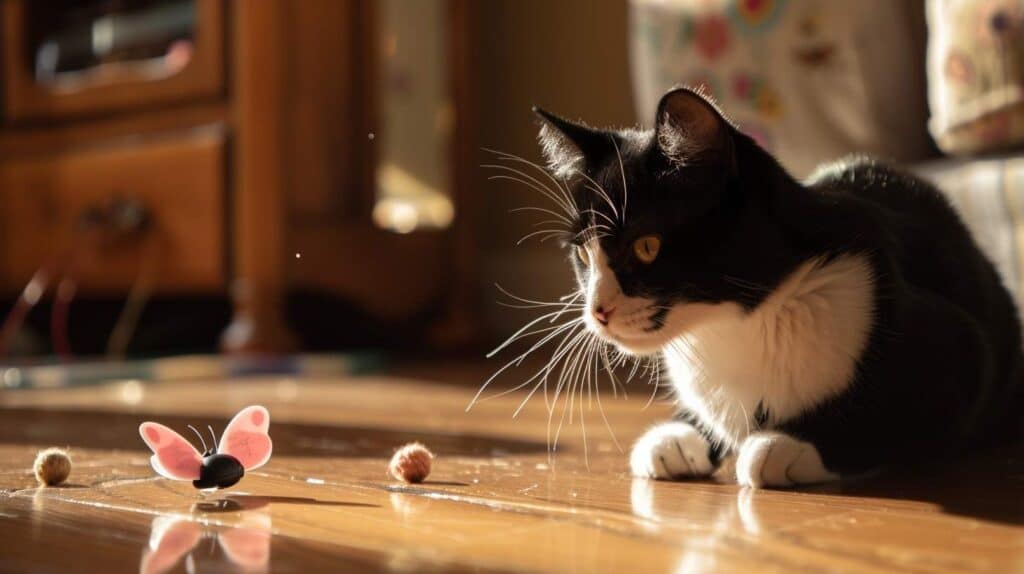
Motorised wands and butterfly toys – automated versions of wand play that flutter and spin automatically. Look for models with variable speed settings and built-in rest intervals (which prevent overstimulation and conserve battery).
Electronic mice and rolling balls – erratic, sensor-triggered movement mimics small prey. Many include tail attachments or feathers to add tactile interest.
Interactive flicker toys – light patterns projected onto walls or floors that move unpredictably. Less satisfying than physical toys (cats cannot catch light) but useful as supplementary stimulation.
How to use them well:
- Rotate automated toys to prevent habituation – a toy left out continuously becomes invisible within days
- Supervise initial use to ensure your cat is not distressed or overstimulated
- Use automated toys to supplement owner-led play, not replace it entirely
3. Puzzle Feeders and Food Toys
Best for: Mental enrichment, slowing down fast eaters, overweight cats, cats prone to boredom
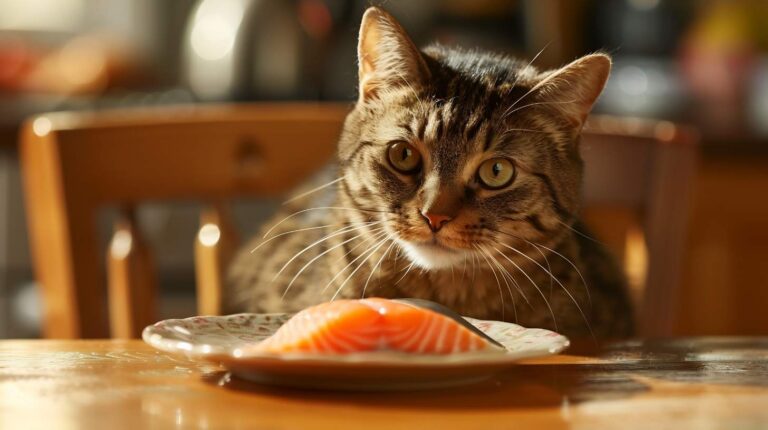
Puzzle feeders make cats work for their food by hiding kibble or treats inside structures that require problem-solving to access. They engage the cat’s intelligence rather than purely their physical drive, and they extend mealtime from seconds to minutes – reducing boredom and slowing caloric intake.
Types of puzzle feeders:
Stationary puzzles – trays, boards, or boxes with holes, tunnels, or levers that require the cat to manipulate to extract food. Nina Ottosson and Doc & Phoebe’s are well-regarded brands.
Rolling food dispensers – balls or cylinders that release kibble as the cat bats them around. Simple, durable, and suitable for most cats.
Hunting feeders – small mouse-shaped containers that kibble is loaded into and hidden around the house, simulating the natural foraging behaviour of a cat that catches multiple small prey throughout the day.
How to use them well:
- Start with easy puzzles and increase difficulty gradually
- Introduce puzzle feeders at regular mealtimes, not just as extras
- Multiple small feeding puzzles placed in different locations best replicate natural foraging
- Cats that have never used puzzle feeders may need to be shown the food inside before they understand the mechanism
4. Catnip and Silvervine Toys
Best for: Independent play, encouraging sedentary cats, scent stimulation
Catnip (Nepeta cataria) triggers a temporary euphoric response in approximately 50-70% of cats, caused by the compound nepetalactone binding to receptors in the nasal tissue. The effect lasts 5-15 minutes, after which cats become temporarily immune for 30-60 minutes. Not all cats respond – sensitivity is genetic and typically does not appear until around 6 months of age.
Silvervine (Actinidia polygama) is a plant from East Asia that produces a similar but distinct response, and notably affects some cats that do not respond to catnip. Research suggests a higher proportion of cats respond to silvervine than to catnip.
Catnip and silvervine toys are best used periodically to re-energise interest in a toy or as reward after play. Using them too frequently reduces their effect.
Safety note: Catnip is safe for cats in normal amounts. Very large ingestion can cause mild vomiting or diarrhoea. The response is non-addictive.
5. Tunnels and Crinkle Toys
Best for: Hiding, ambush play, kittens, multi-cat households
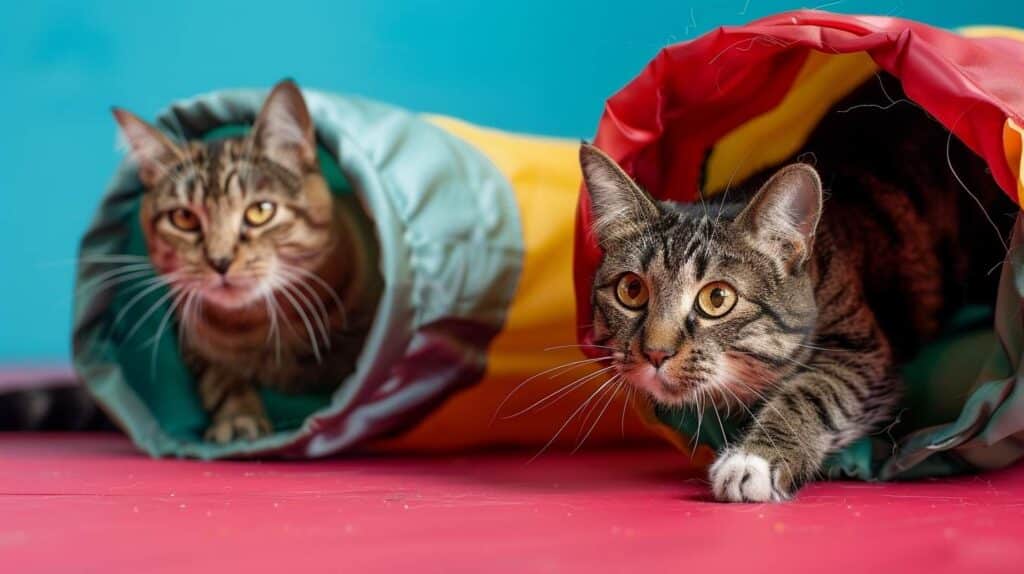
Collapsible fabric tunnels provide cats with a place to hide, stalk from, and burst out of – satisfying the ambush component of the hunt sequence. Crinkle materials inside the tunnel add auditory stimulation that many cats find compelling.
Tunnels are particularly useful in multi-cat households as they provide retreat spaces and structured play options that do not require direct competition between cats.
6. Laser Pointers
Best for: High-intensity physical exercise (with caveats)
Laser pointers trigger intense chase responses in most cats, providing excellent physical exercise. However, they have a significant behavioural limitation: the cat can never catch the laser dot. This means the hunt sequence is never completed, which can create frustration and compulsive light-chasing behaviour in some cats.
Best practice if using lasers:
- Always end a laser session by directing the dot onto a physical toy that the cat can catch
- Follow with a treat to complete the hunt-eat sequence
- Never shine the laser directly into a cat’s eyes
- Monitor for signs of obsessive behaviour – some cats develop compulsive chasing of light or reflections after extensive laser use
For cats showing any signs of light-fixation or compulsive behaviour, discontinue laser use and switch to physical toys.
How to Use Interactive Toys Effectively
Having the right toys is only part of the equation. How you use them matters just as much.
Play Frequency and Duration
Short, frequent sessions are more effective than occasional marathon play. Aim for two to three sessions of 10-15 minutes daily, ideally timed around dawn and dusk – when cats are naturally most active (they are crepuscular animals).
Many owners find that a structured play session before the last meal of the day is particularly effective. It completes the hunt-eat sequence naturally and helps cats settle for the night.
Rotation Is Essential
A cat left with the same toys available every day will ignore them within a week. Rotating toys – putting some away and reintroducing them after a few days – keeps each toy feeling new and interesting. Aim to have 5-8 toys in rotation, with only 2-3 available at any time.
Matching Toys to Your Cat’s Personality
| Cat Type | Best Toy Match |
|---|---|
| High-energy, young | Wand toys, automated toys, tunnels |
| Intelligent, curious | Puzzle feeders, hunting feeders |
| Sedentary, older | Easy puzzle feeders, gentle wand play, catnip toys |
| Anxious | Wand play (builds confidence), gentle automated toys |
| Multi-cat household | Tunnels, separate puzzle feeders, wand play with each cat individually |
| Kitten | Wand toys, soft plush toys, tunnels, balls |
| Deaf or visually impaired | Vibrating toys, toys with strong scent (catnip/silvervine) |
Never Use Hands or Feet as Toys
One of the most common mistakes with kittens and young cats is playing with them using hands or feet. This teaches them that human body parts are prey, resulting in bite and scratch habits that become painful and difficult to change as the cat grows. Always use a toy as an intermediary.
Signs Your Cat Needs More Interactive Play
| Sign | What It Suggests |
|---|---|
| Waking you at night to play | Under-stimulated, energy not discharged |
| Attacking your ankles or feet | Redirected predatory behaviour |
| Excessive scratching of furniture | Boredom, needs outlet |
| Weight gain despite normal feeding | Insufficient physical activity |
| Overgrooming | Anxiety or boredom – play can help |
| Aggression toward other cats | Redirected energy, competition |
| Pacing, restlessness | Under-enriched environment |
Frequently Asked Questions About Interactive Cat Toys
Choosing Toys
What is the best interactive cat toy for indoor cats? The most consistently effective toy across different cats is a feather wand – specifically one that allows you to create unpredictable prey-like movement. For solo play, electronic automated toys with rest intervals work well. For mental enrichment, puzzle feeders are the most beneficial. Most cats benefit from a combination of all three types.
How do I know if my cat is enjoying a toy? Signs of genuine engagement include stalking posture (low body, focused eyes, slowly twitching tail), active chasing and pouncing, chattering sounds (a rapid jaw movement cats make when watching prey), and returning to the toy repeatedly. A cat that walks away after one glance or bats the toy once is not engaged – try a different type of movement or toy.
My cat ignores most toys. What should I try? Some cats need encouragement to engage with toys, particularly if they have not been played with regularly. Try wand toys first, as the movement you can create most closely mimics live prey. Sprinkle a small amount of catnip near the toy to spark interest. Play at dawn or dusk when your cat is naturally most active. Be patient – previously sedentary cats sometimes take weeks to warm up to interactive play.
Safety Questions
Are electronic cat toys safe to leave unsupervised? Many are designed for unsupervised use, but use common sense. Toys with small detachable parts, strings, or feathers should be put away when you are not present. Automated toys with rest intervals are safer than those that run continuously, as continuous motion can overstimulate some cats.
How often should I replace cat toys? Replace toys when they show signs of damage – chewed-through fabric, detaching parts, fraying strings, or broken mechanisms. A damaged toy can be a choking or ingestion hazard. Check toys regularly, especially well-loved ones.
The Bottom Line
Interactive play is not an optional extra for indoor cats – it is a genuine health requirement that addresses physical fitness, mental wellbeing, and behavioural balance simultaneously. The investment of two or three short play sessions a day pays dividends in a calmer, healthier, more content cat.
The best approach combines owner-led wand play (which nothing else can replicate for bonding and hunting satisfaction), automated toys for independent enrichment, and puzzle feeders for mental stimulation at mealtimes. Rotate your toy selection regularly, always let your cat finish with a successful catch, and match the toy type to your individual cat’s energy level and preferences.
A well-played cat is a happy cat – and usually a much less destructive one too.
This article is for informational purposes only. If your cat’s behaviour problems persist despite increased play and enrichment, consult your veterinarian to rule out underlying medical or psychological causes.