Why Does My Cat Stare at Me? 7 Reasons Behind That Unblinking Gaze
- Quick Answer: Cats stare at their owners for several distinct reasons – hunger, affection, curiosity, attention-seeking, fear, play drive, or simply out of habit. A stare is rarely random. The body language surrounding the stare – ear position, tail movement, pupil size, and posture – tells you exactly what your cat is communicating. A soft, slow-blinking stare means trust and affection. A hard, unblinking stare with a tense body is a warning. Learning to read these signals transforms an unsettling gaze into a clear conversation.
- Expert Source: Behavioural explanations in this article are drawn from Dr. Wailani Sung, veterinary behaviourist and contributor to PetMD’s cat behaviour section, guidance from the American Association of Feline Practitioners (AAFP), research published in Behavioural Processes on feline visual communication with humans, and the study “Slow blink eye-closure as a positive emotional signal in cats” published in Scientific Reports (2020) by Leanne Proops et al.
Last Updated: April 2026

You are sitting on the sofa reading or watching something on your phone. You look up and your cat is just – there. Sitting perfectly still, eyes fixed on you with an expression that is somewhere between profound wisdom and mild accusation. No blinking. No movement. Just the stare.
Most cat owners know this experience well, and most of them have wondered at some point whether they should be flattered, concerned, or mildly alarmed.
The good news: the stare almost always means something specific. Cats do not make sustained eye contact for no reason – they use their gaze as one of their primary tools for communicating with the people they live with. Once you know what to look for, that mysterious unblinking look becomes surprisingly easy to read.
Why Do Cats Stare? The Short Science
Cats evolved as both predators and prey. Their visual system is extraordinarily sensitive to movement and light – far more so than ours – and they use sustained eye contact in two distinct social contexts: as a tool of communication with trusted companions, and as an assertion of dominance or threat detection with unknown animals.
With humans they know well, the stare functions primarily as communication. Research published in Behavioural Processes found that cats use a combination of vocalisations and visual cues – including direct eye contact – to communicate their needs to their owners. Unlike dogs, cats did not co-evolve with humans over the same extended period, which means their communication is more subtle and requires more interpretation. The stare is one of the most direct signals they have.
Understanding the stare requires reading the whole picture – not just the eyes, but the ears, tail, body posture, and whether the cat is blinking or rigid.
The 7 Reasons Your Cat Is Staring at You
Reason 1: Hunger – The Most Common Cause
If your cat stares at you with steady focus, particularly in the late afternoon, near the kitchen, or next to their food bowl, food is almost certainly the explanation.
Cats are highly food-motivated and develop precise internal clocks around mealtimes. They learn quickly that eye contact with their owner is one of the most effective ways to prompt feeding. Research shows that cats can learn to use visual cues – including sustained staring – to manipulate human behaviour. If you have ever fed your cat after they stared at you long enough, you have trained them to do it again.
What it looks like: Steady, calm stare – often accompanied by sitting near the food bowl, meowing, or following you into the kitchen. Body language is relaxed, ears forward, tail may flick with mild impatience.
What to do: Stick to a consistent feeding schedule. If the staring starts well before mealtimes, avoid reinforcing it by feeding early – this extends the behaviour.

Reason 2: Affection – The “Cat Kiss”
One of the most meaningful things a cat can do is look at someone they trust and slowly close and open their eyes. This behaviour – called the “slow blink” – has been documented in scientific research as a genuine positive emotional signal between cats and humans.
A 2020 study published in Scientific Reports found that cats were significantly more likely to approach a human and slow-blink back when the human initiated a slow blink, compared to a neutral expression. The researchers concluded that slow blinking represents a positive emotional state and functions as a form of communication that promotes affiliation.
When your cat stares at you softly and then delivers a slow blink, they are expressing comfort, trust, and affection. In feline terms, closing your eyes in front of another individual is a display of vulnerability. Doing it while looking at you means they consider you safe.
What it looks like: Relaxed, soft-eyed stare from a relaxed body. Often accompanied by slow blinking, purring, or simply resting nearby while maintaining gentle eye contact.
What to do: Slow blink back. Gently close your eyes for a second or two, then open them. Your cat will often return the gesture – and research confirms this actually increases positive responses from them.
Reason 3: Curiosity and Observation
Cats are observational animals. They gather information about their environment constantly, and you – moving, making sounds, smelling of different things throughout the day – are one of the most reliably interesting elements of their world.
A stare accompanied by head tilting, alert ears, or following your movements is most likely simple curiosity. Your cat is processing information about what you are doing, how you are feeling, and whether anything happening near you is relevant to them.
This type of staring increases when you are doing something unfamiliar – using a new tool, wearing unusual clothing, behaving differently than normal. Cats are highly sensitive to pattern changes in their environment, and you are part of that pattern.
What it looks like: Alert, interested stare. Head may tilt. Ears forward. Body relaxed but engaged. No tension in posture.
What to do: Nothing specific needed – this is healthy curiosity. You can narrate what you are doing in a calm voice if you like; many cats find their owner’s voice reassuring.
Reason 4: Attention-Seeking
Some cats learn that staring is an efficient way to initiate interaction. If eye contact from them consistently leads to you talking to them, petting them, or playing with them, they will use it deliberately.
This is a learned behaviour reinforced through your responses. The cat is not being manipulative in any negative sense – they are simply using what works. Staring is quieter than meowing and often more effective.
Attention-seeking stares frequently occur during times when you are focused elsewhere – working at a computer, watching television, or talking on the phone. The cat has noticed that your attention is not on them and is attempting to redirect it.
What it looks like: Stare directed specifically at your face, often from close range. May be accompanied by approaching you, sitting on your keyboard or book, placing a paw on you, or gentle chirping sounds.
What to do: If you want to reduce the behaviour, avoid rewarding it with immediate attention every time. Instead, schedule regular interactive play sessions so the cat’s need for engagement is met proactively rather than on demand.

Reason 5: Hunting Instinct and Play Mode
Cats are obligate carnivores with hardwired hunting instincts. The predatory behaviour sequence – stare, stalk, chase, pounce, catch – begins with a sustained, focused gaze. When your cat stares at you from across the room with dilated pupils and a low, tense body, they may be in play mode rather than expressing an emotion about you.
This type of staring is particularly common in young cats and kittens, and in cats that do not receive enough interactive play. The cat has identified you – or part of you, often your feet or hands – as a potential target for a predatory sequence.
What it looks like: Intense, fixed stare from a crouched, low body position. Pupils may be dilated. Tail may flick or twitch. The rear end sometimes wiggles before a pounce.
What to do: Redirect immediately to an appropriate toy. A wand toy or feather toy gives the cat a legitimate target for the full predatory sequence. Never use your hands or feet as play targets – this teaches cats to treat human body parts as prey.
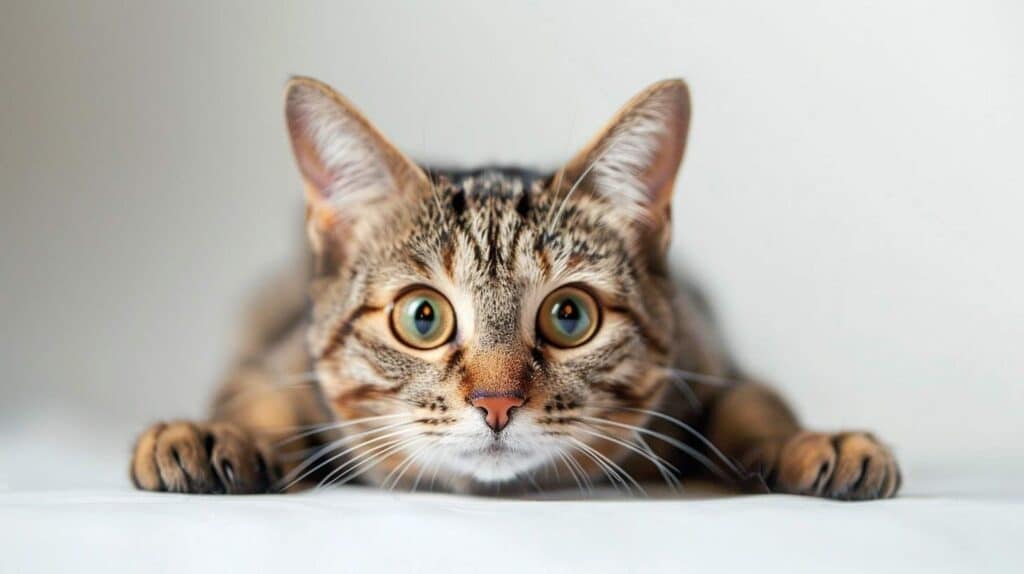
Reason 6: Fear or Anxiety
A cat that is frightened or unsettled will stare at the source of their discomfort as a threat-monitoring behaviour. They are not trying to communicate with you – they are tracking a perceived danger.
Fear-based staring is easy to distinguish because the accompanying body language is unmistakable. The cat is not relaxed. This type of stare can be directed at you if you have done something that startled the cat, or if your behaviour has changed in a way that seems threatening.
What it looks like: Hard, wide-eyed stare with a tense, low body. Ears flattened or rotated back. Pupils dilated. Tail low or tucked. May be combined with hissing, growling, or hiding.
What to do: Do not approach or attempt to reassure a fearful cat with touch – this often escalates rather than reduces the fear. Give them space and time. Move slowly, speak calmly, and let the cat come to you on their own terms when they feel safe.
Reason 7: Warning or Asserting Boundaries
A hard, sustained, unblinking stare with a stiff body and piloerection (fur standing up along the spine and tail) is a direct warning – the cat is communicating that they are at their limit and require space.
This is the one type of staring that genuinely requires a response. In feline body language, this stare precedes aggression if the other party does not retreat. It is not inherently directed at you as an owner – it may be triggered by a specific situation, another animal, or accumulated overstimulation during petting.
What it looks like: Unblinking, fixed stare with a very tense, still body. Fur may be raised. Tail stiff or lashing. No slow blinking. Expression is hard rather than soft.
What to do: Avert your gaze immediately – holding eye contact with a cat giving a warning stare is perceived as a counter-challenge. Give the cat significant space. Do not attempt to touch, speak to, or approach them until the body language softens completely.
How to Read Any Cat Stare in 5 Seconds
| Body Language | What the Stare Means |
|---|---|
| Slow blink, relaxed body, purring | Affection and trust |
| Near food bowl, calm but persistent | Hunger |
| Alert ears, head tilt, no tension | Curiosity |
| Close range, paw on you, chirping | Attention-seeking |
| Low body, dilated pupils, tail twitching | Play drive / hunting mode |
| Flat ears, low body, wide eyes | Fear – give space |
| Stiff body, piloerection, no blink | Warning – back off |
The Slow Blink: How to Respond to an Affectionate Stare
If your cat is staring at you softly and you want to respond in a way they understand, the slow blink is the most scientifically supported option.
From a distance of 1-2 metres, make relaxed eye contact with your cat. Then gently close your eyes for one to two seconds, then open them slowly. Avoid squinting aggressively or maintaining an intense stare before the blink – keep your whole face relaxed.
Research by Leanne Proops and colleagues confirmed that cats are significantly more likely to approach and engage with a human who slow-blinks than one who maintains a neutral expression. The slow blink is one of the rare instances where human behaviour that is natural to us (relaxed blinking) directly translates into positive communication in another species.
When Staring Is Worth Discussing with a Vet
The vast majority of cat staring is entirely normal behaviour. However, there are specific scenarios where a sudden change in staring behaviour warrants veterinary attention:
- Staring at walls or empty spaces with no apparent stimulus, particularly in older cats – this can be associated with cognitive dysfunction syndrome (feline dementia) or neurological issues
- Staring accompanied by sudden personality change, confusion, or disorientation
- Staring combined with other new behavioural changes – changes in appetite, litter box use, grooming, or activity levels
- Any staring that appears associated with pain, such as sensitivity when touched or changes in posture
In young, healthy cats, changes in staring behaviour are almost always behavioural rather than medical. In cats over 10 years, it is worth mentioning new behavioural patterns to your vet at the next routine appointment.
Frequently Asked Questions About Cat Staring
Understanding the Behaviour
Is it normal for cats to stare at you constantly? Yes – for many cats, watching their owner is simply part of their daily routine. Cats are observational animals who use visual information to feel secure in their environment, and you are one of the most predictable and interesting elements of that environment. Constant, relaxed staring from a calm cat is not a cause for concern.
Why does my cat stare at me while I sleep? Cats are crepuscular – naturally most active around dawn and dusk. If your cat is awake at 4am while you are asleep, staring at you is a fairly natural behaviour. They may be waiting for you to wake up, monitoring their environment with you as a familiar anchor point, or simply passing time. Cats often watch over their owners during sleep – it is considered a sign of attachment rather than anything threatening.
Why does my cat stare at me without blinking? Cats do not need to blink as frequently as humans – their eye physiology is different. A relaxed, infrequent-blinking stare is normal. The absence of blinking only becomes significant when combined with a tense body, rigid posture, and the other warning signs described above. Soft, infrequent blinking from a relaxed cat is simply normal feline behaviour.
Does my cat staring at me mean they love me? It can – particularly if the staring is accompanied by slow blinking, purring, relaxed body language, or choosing to rest near you while maintaining gentle eye contact. These are all positive affiliative signals. A cat that stares at you while fully relaxed is not threatened by you and actively chooses to include you in their awareness – which in cat terms is a meaningful expression of comfort and trust.
Responding to the Stare
Should I stare back at my cat? It depends on the context. With a relaxed, affectionate stare – yes, you can make soft eye contact and slow-blink back. With a warning stare – no, absolutely not. Maintaining a hard stare at a cat that is already showing warning signs will be interpreted as a counter-challenge and increases the risk of aggression. Always read the full body language before making eye contact.
My cat stares at me and then meows. What does that mean? This is a very deliberate communication – the cat has identified you as the relevant party and is escalating to vocalisation to make sure you respond. Most commonly this is a hunger-related request, particularly if it occurs near mealtimes. It can also be a request for attention or play. The meow combined with staring is one of the clearest signals a cat can give.
The Bottom Line
Your cat staring at you is almost never random or meaningless. It is one of their primary communication tools – used to express hunger, affection, curiosity, play drive, fear, and boundary warnings. The stare itself only tells half the story; the body language that accompanies it tells you everything you need to know about what they are communicating.
Take a few seconds to observe the full picture each time: are the ears forward or flat, is the body relaxed or tense, is there slow blinking or a hard unblinking gaze? Within a few weeks of paying attention, you will find that your cat’s stares become as readable as words. And when your cat settles across the room, looks at you with soft eyes, and slowly closes them – you will know exactly what they mean.
New cat? Find a name as unique as their character.
Browse 600+ cat names by gender and personality type — because every cat has a story.
Try Pet Name FinderThis article is for informational purposes only and does not replace advice from a qualified veterinarian or certified cat behaviourist. If your cat shows sudden changes in behaviour, contact your vet.